12 Essential Career Fair Metrics to Measure Real Success

For a long time, the success of a career fair was judged by the buzz around it: how crowded the aisles were or how long the lines stretched at the recruiter booths. But today, a busy room is a vanity metric if it doesn’t lead to a hire.
Whether you are running a high-tech virtual career fair platform or a traditional in-person hall, you need hard data to prove your event actually worked. Without it, you’re measuring activity, not outcomes.
Organizers need clear event metrics to move beyond guesswork and start making strategic improvements for future events. Employers need visibility into candidate engagement and brand impact to justify their participation. Without measurable results, both are operating on assumptions.
By tracking the right data, both sides can measure true event ROI rather than just counting heads.
In this guide, we break down the 12 most critical career fair metrics to track, why they directly impact your bottom line, and how to use those insights to build more effective, scalable events.
{{table-of-contents}}
Why Career Fair Metrics Matter

Tracking the right career fair metrics doesn’t just measure success. It defines it. For organizers, these insights are essential for proving sponsor and employer value, which directly influences whether companies choose to return for future events.
Beyond retention, metrics give you control over performance:
- Optimize the Experience: Data shows exactly what’s working (and what isn’t). Use it to refine your event layout, adjust programming, and remove friction from the attendee journey in real-time.
- Benchmark for Growth: Year-over-year data lets you spot trends in attendance and engagement, making it easier to see if your strategy is improving or stalling
- Strategic Budgeting: With hard numbers, budget decisions shift from guesswork to allocation. You can identify where spend drives results and where it doesn’t.
Strong metrics turn a one-off career fair into a repeatable, scalable recruiting system that delivers measurable results.
The Most Important Career Fair Metrics to Measure
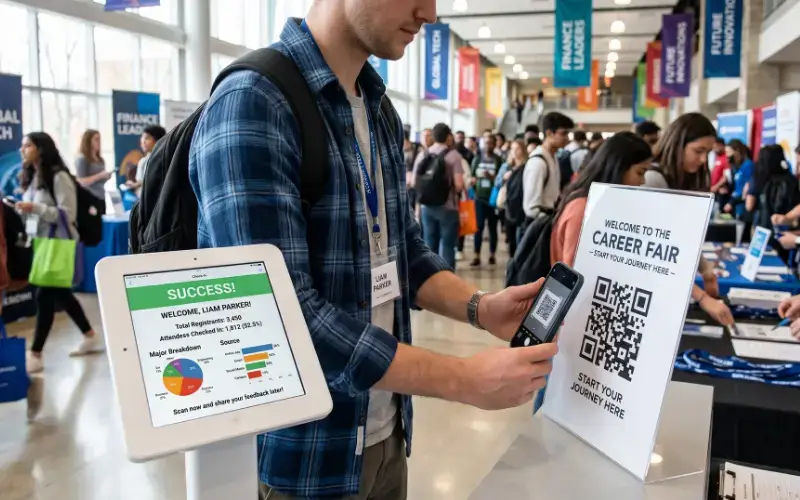
Measuring career fair success goes far beyond counting attendees or registrations. The real value comes from understanding how effectively your event drives engagement, connects employers with talent, and creates meaningful interactions.
These metrics help organizers and companies evaluate performance and continuously improve future events.
1. Total Registrations
This is your primary indicator of top-of-funnel interest. It reflects how well your event is being promoted and whether your messaging actually resonates with your target audience.
- What to track: Total sign-ups, landing page conversion rates, and the performance of specific email marketing or social campaigns. These metrics show where your audience is coming from and which channels are driving the highest-quality traffic.
- Why it matters: Registrations help you gauge awareness, forecast demand, and plan staffing. But volume alone is not enough. High registration numbers without corresponding attendance or engagement signal a breakdown between interest and intent.
2. Attendance Rate
Attendance rate measures how much of your registered interest converts into actual participation. It’s a direct test of intent.
Formula: attendance ÷ registrations × 100
- What to track: Actual turnout, reminder effectiveness, and no-show rates. This helps you identify gaps between interest and participation. For example, low attendance may point to weak follow-up communication or scheduling conflicts.
- Why it matters: This metric sharpens demand forecasting, improves capacity planning, and forces better follow-up strategies. A low attendance rate signals that your registrations are inflated or poorly qualified, not that your event underperformed.
3. Employer Participation Rate
A strong employer lineup drives perceived value and candidate turnout.
- What to track: Number of participating companies, active recruiter career fair booths, and the mix of new versus first-time employers. This gives you a clearer picture of how diverse and attractive your event is from a candidate perspective.
- Why it matters: This directly impacts event credibility and the range of opportunities available for candidates.
4. Booth Traffic / Employer Booth Visits
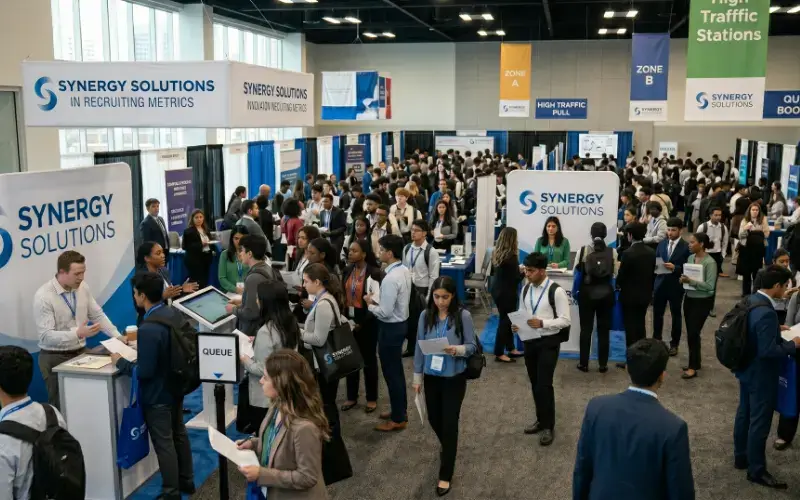
This is a direct indicator of employer visibility and candidate interest.
- What to track: Total booth visits, average visits per employer, and peak traffic times. This works for virtual clicks or in-person foot traffic and QR code scans. These patterns reveal where attention concentrates and where it drops off.
- Why it matters: It demonstrates sponsor ROI and exposes imbalances in visibility. High traffic concentrated on a few booths means your layout or promotion strategy is failing the rest.
5. Candidate Engagement Metrics
Engagement metrics go beyond attendance to show how actively candidates are participating.
- What to track for virtual events: Number of chat messages sent between candidates and employers, video meeting joins, session duration, profile clicks, and resource downloads.
- What to track for in-person events: Recruiter conversations, resume handoffs, and booth dwell time.
- Why it matters: These interactions reveal how serious candidates are. Low engagement with high attendance indicates passive participation, not real hiring potential.
.webp)
6. Session & Workshop Attendance
.webp)
If your event includes keynotes or panels, session attendance is a key signal of content relevance and audience intent
- What to track: Attendance across keynotes, breakout sessions, employer presentations, and Q&A discussions. Monitor drop-off rates to see where attention declines.
- Why it matters: Strong attendance with low drop-off signals relevant programming. High drop-off indicates content misalignment or weak delivery.
7. Resume Submission / Application Interest Rate
This metric captures how many candidates move from browsing to expressing real interest.
- What to track: Resumes submitted at booths, applications started, and job interest forms completed. The exact interaction will vary depending on how your career fair is structured, some events focus on resume drops, while others support full applications or employer-specific interest forms.
- Why it matters: This is the strongest indicator of how well your event aligns talent with available roles.
8. Candidate Satisfaction Score
Post-event feedback is essential for understanding the attendee experience.
- What to track: Post-event survey responses measuring ease of use, networking quality, employer relevance, and overall event value, typically captured using rating scales (e.g., 1–5 scores or NPS).
- Why it matters: High satisfaction leads to stronger word-of-mouth and increased return attendance, and better long-term growth.
9. Employer Satisfaction Score
Recruiter feedback is arguably just as important as candidate feedback, if not more.
- What to track: Employer survey scores rating candidate quality, booth engagement, event logistics, and overall experience, typically measured on a 1–5 scale or through NPS-style feedback.
- Why it matters: Employer satisfaction is one of the strongest predictors of sponsor retention and long-term event success.
10. Repeat Employer / Sponsor Retention Rate
Retention tells you whether your event is delivering consistent value to employers.
- What to track: Number of returning companies sponsor renewal rates, and participation across multiple events.
- Why it matters: High retention signals a sustainable event model and reliable ROI.
11. Post-Event Interview & Hiring Outcomes

While not always directly accessible, hiring outcomes help connect event performance to real results.
- What to track: Interviews scheduled, candidates shortlisted, and hires attributed to the event. If you have access to employer hiring data, either as a participating employer, through follow-up reporting, or in single-employer events, this metric helps bridge the gap between engagement and hiring outcomes.
- Why it matters: It ties event activity to tangible recruiting results, making your impact undeniable.
12. Overall Career Fair ROI
A high-level measure of whether the event delivered value relative to its cost.
- How it’s evaluated in practice: Through a combination of engagement metrics (booth visits, sessions), employer satisfaction, and reported hiring outcomes where available.
- Why it matters: It helps organizers and employers understand whether the event generated enough value to justify future investment.
From Data to Action: Avoiding the "Vanity Metric" Trap
Collecting data is only half the battle; the real win comes when you move past surface-level vanity metrics. High registration numbers or social media impressions might look great on a slide deck, but they don't guarantee actual participation or candidate quality. To build a repeatable, high-ROI event, you must turn raw insights into strategic adjustments.
How to act on your data while avoiding common pitfalls:
- Optimize Your Layout: Identify your heavy hitters, the employers that act as candidate magnets. Instead of letting them crowd one corner, use this data to place high-traffic booths strategically. Pull attendees through the entire space and give quieter booths more visibility.
- Perfect Your Programming: Don’t waste your best content on a dead hour. Analyze peak engagement trends to schedule headline keynotes or networking mixers exactly when your audience is most active.
- Refine Your Marketing Spend: Stop shouting into the void. If 80% of your sign-ups come from LinkedIn, stop over-investing in expensive email lists or physical flyers that aren't converting.
- Prioritize Connections Over Clicks: A thousand booth views mean nothing without intent. Shift your focus from surface-level engagement to deep interactions, like resume submissions and chat messages, to ensure recruiters see the value in returning.
- Close the Feedback Loop: Treat employer satisfaction as seriously as student feedback. If recruiters find the tech frustrating or the talent pool mismatched, they won't return. Use year-over-year retention data to ensure your strategy is actually evolving, not just spinning its wheels.
When you act on actionable data, you stop guessing what your audience wants and start delivering a career fair that gets more efficient and impactful every year.
Mastering Career Fair Metrics for Long-Term Success
Career fairs reach their full potential when success is measured purposefully, rather than assumed based on a crowded room. The right metrics allow both organizers and employers to move beyond surface-level activity and truly understand the drivers of engagement, candidate interest, and long-term institutional value.
When these insights are tracked consistently, they do more than just evaluate a single day. They actively shape how future career fairs are designed, promoted, and experienced. This data-driven approach leads to stronger employer relationships, superior candidate experiences, and significantly more efficient recruiting outcomes.
To achieve this level of visibility, your virtual career fair platform needs to be as smart as your strategy. Remo helps organizers and companies track engagement in real time, providing the depth of interaction data needed to create connected, impactful, and measurable career fairs from start to finish. Book a demo today and see how we can help you turn your next event into a data-driven success story that’s easy to justify and even easier to scale.
FAQs about Career Fair Metrics
1. What is a good attendance rate for a career fair?
A strong attendance rate for a career fair depends on the event format and audience, but most organizers aim for a significant portion of registered participants to attend. Higher attendance usually reflects effective targeting, promotion, and pre-event communication.
2. Why is employer satisfaction important in career fairs?
Employer satisfaction is important because it determines whether companies will return for future events. It reflects candidate quality, booth engagement, and overall experience, making it a key factor in long-term event success and sponsor retention.
Aniqa Iqbal
Aniqa is a content writer at Remo, where she merges her love for storytelling from movies and TV shows with her passion for creating compelling content. With a knack for blending pop culture references and relatable narratives, Aniqa crafts content that informs and resonates deeply with readers. She aims to strike a chord with her audience, fostering genuine connections through words that inspire, engage, and entertain. When she's not writing, Aniqa can be found binge-watching her favorite shows, always on the lookout for the next story to tell.