Why Higher Ed Needs More Than Just Zoom for Virtual Career Fairs

For the better part of a decade, Zoom was enough. It carried classrooms through a global shutdown and kept career services running when in-person fairs disappeared. Universities needed a fast, familiar way to keep career fairs alive, and video conferencing tools like Zoom and Google Meet stepped in as reliable bridges. They were convenient, accessible, and already embedded in higher education workflows.
But emergency solutions aren’t long-term strategies.
A career fair isn’t just a series of calls. It’s a structured, high-energy marketplace of opportunity. When you flatten that experience into a grid of muted thumbnails and clunky breakout rooms, you don't just lose the atmosphere, you lose the data, the efficiency, and ultimately, the employers who fund the ecosystem. Generic video platforms enable calls, but they fail to recreate the energy and structure that makes career fairs effective in the first place. As student expectations rise and employers demand clearer return on investment, the gap between “video call” and “career fair” becomes harder to ignore.
This article breaks down the key reasons generic video platforms fall short for virtual career fairs today, and explores what a purpose-built virtual career fair platform looks like.
{{table-of-contents}}
The Proximity Illusion: When “Connected” Doesn’t Mean Engaged
.webp)
A Zoom-based career fair may attract hundreds of logged-in students, but attendance alone doesn’t create engagement. Many enter what feels like a “Digital Ghost Town”, a static environment where meaningful interaction is harder to initiate than in a crowded gymnasium.
The fundamental flaw of the generic video call is the, “Proximity Illusion”. In a physical room, being near someone allows for eye contact, social cues, and the ability to overhear a conversation that sparks interest. In a Zoom meeting, proximity is binary: you are either in the meeting or you are out.
When students enter a massive, undifferentiated Zoom meeting, they don't feel present; they feel observed. The result is a specialized form of disengagement. Students keep their cameras off, stay on mute, and wait for a safe moment to leave. They are technically "connected" to the infrastructure of the university, but they are psychologically disconnected from the opportunity.
Unlike purpose-built virtual job fair platforms, which are designed to structure movement and surface active conversations, virtual meeting tools like Zoom treat everyone as participants in the same static session. They were built for presentations and team meetings, not for dynamic marketplace-style interaction. When that architecture is used to host a career fair, the limitations begin to show.
And the problem doesn’t stop at passive students, it compounds behind the scenes.
The Breakout Room Bottleneck: When Logistics Kill Momentum
.webp)
To recreate the feel of multiple booths, many universities rely on breakout rooms within meeting tools like Zoom. On paper, the model appears simple: assign each recruiter a room and move students in and out. In practice, this setup creates friction for both career services staff and students.
For career services staff, they find themselves manually directing traffic, moving Student A into Employer B’s room, answering private chat messages, troubleshooting access issues, and monitoring who has been waiting the longest. The focus shifts from facilitating meaningful connections to simply keeping the system running.
For students, the experience can feel equally disjointed. In a physical fair, you can see a long line and decide to visit another booth. On Zoom, the queue is invisible, a student has no way of knowing if a recruiter is free, mid-pitch, or five minutes away from a break. The event becomes less about discovery and exploration and more about a strict schedule of meetings.
When movement depends on manual transfers and invisible queues, the natural rhythm of a career fair disappears. What should feel like fluid exploration becomes a managed sequence of transactions.
But even if breakout rooms ran perfectly, the following issue would remain.
.webp)
Lost in Translation: Why Video Alone Fails the Career Mission
In the traditional architecture of a physical career fair, the most valuable moments often happen during the walk between the entrance and a specific destination. A student might arrive with the sole intent of speaking to a Big Four accounting firm, but on the way, they pass a vibrant booth for a mid-sized tech consultancy they’ve never heard of. They overhear a compelling pitch, see a high-energy demo, and five minutes later, a new career path is forged. This is discovery, and it is the heartbeat of a successful fair.
Generic video tools like Zoom quietly strip that away.
When a career fair on a standard meeting tool is reduced to links and breakout rooms, it starts to function like a calendar full of pre-booked meetings. Students gravitate toward the employers they already recognize and those rooms fill up quickly. Meanwhile, lesser-known companies sit empty, not because they lack opportunities, but because they lack visibility.
The industry often blames bad connection or poor video quality for these failures, but that’s not the problem. Platforms like Zoom deliver clear audio and stable video. The failure isn’t technical. It’s architectural. To run a successful online career fair, you don’t just need a camera; you need a dedicated virtual job fair platform that recreates the spontaneous conversations and natural exploration that define an in-person event. Students should be able to “walk” between booths, notice activity, pivot toward opportunity, and discover employers they didn’t plan to meet. Without that movement, a career fair becomes a series of isolated calls instead of a dynamic marketplace.
From Video Calls to Environments: The Rise of Purpose-Built Virtual Career Fair Platform Solutions
To move beyond the limitations of generic video, we must first stop viewing a virtual career fair as a meeting and start viewing it as a digital venue. The gold standard for a successful event is an environment that restores the three pillars of recruitment: visibility, agency, and interaction.
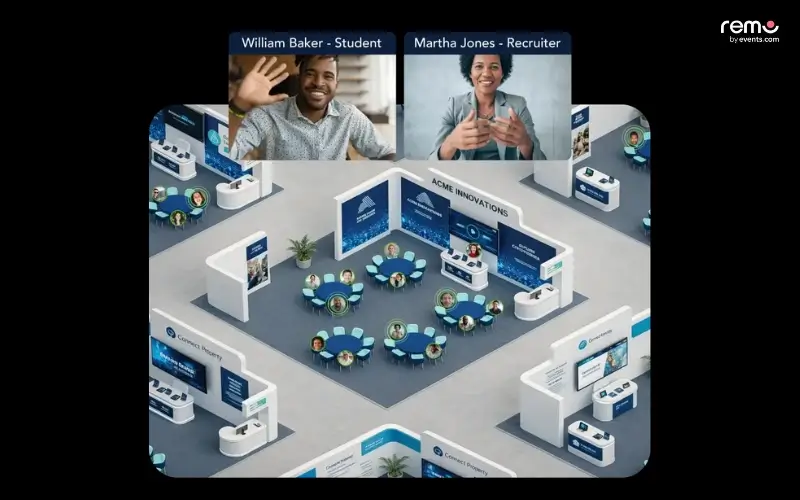
A purpose-built virtual career fair platform doesn't hide opportunities behind a list of links. Instead, it provides a visual map of the event. Imagine an interface where a student can see, in real-time, which booths are buzzing with activity, which employers are engaged in conversations and which have availability. Instead of clustering around a handful of familiar names, they can browse, explore, and pivot naturally just as they would at an in-person career fair. This spatial awareness eliminates the digital blind spot, allowing for the self-directed movement that defines traditional career fairs. When a student can "walk" the floor, they move from being a passive observer to an active participant.
This is where purpose-built platforms like Remo and Brazen have fundamentally shifted the landscape, specifically addressing the "Zoom Plateau" (the point where video conferencing tools like Zoom stop being enough for running effective career fairs) by restoring the mechanics of human interaction.
Remo: Restoring Discovery through Spatial Networking
Remo tackles the "Digital Ghost Town" problem by using highly visual and custom-branded immersive floor plans. Instead of a grid of black boxes, students see virtual booths labeled with employer logos.
- Natural Movement: Students move their avatars from table to table with a single click. This mimics the physical "walk-up," allowing students to hover at a table, listen to a group conversation, and choose which booth or employer to meet, restoring the spontaneity and exploration that define in-person career fairs.
- Visibility as Strategy: Since everyone is visible on the map, the Clustering Effect is naturally mitigated. When a student sees a 20-person crowd at a big-name firm, they can easily pivot to a neighboring company that is currently free, maximizing their time and the employer's ROI.
Brazen: Leaning Into Structured, Scheduled Recruitment
While Remo is designed to recreate the organic movement of a physical career fair online, Brazen takes a more structured approach, leaning into scheduled and automated interactions.
- Smart Queuing: Brazen replaces open browsing with structured queues and time-bound one-on-one chats. Students typically join or pre-book slots, and recruiters move through conversations in a sequential, organized manner.
- Persistent Context: The moment a 1:1 video chat begins, the student’s resume, major, and pre-screened interests are visible to the recruiter. Conversations are controlled, efficient, and appointment-driven rather than exploratory.
Ultimately, the choice depends on the type of career fair experience an institution wants to create. Universities aiming to recreate the energy, movement, and marketplace dynamics of a traditional fair may gravitate toward spatial platforms. Those prioritizing tightly scheduled, appointment-based recruitment may prefer a more structured model.
The problems described are the result of using tools that were never built for hosting virtual career fairs in the first place. By utilizing these purpose-built tools, institutions can let “connecting talent with opportunity” take center stage.
If you’re evaluating options for your next virtual or hybrid career fair, explore our guide to the 6 Best Virtual Career Fair Platforms for Universities in 2026 to see how Remo compares, and which solution best fits your campus goals.
The Strategic Shift: Moving Beyond “Good Enough”
The conversation around virtual career fairs is no longer about survival. It’s about standards.
Today’s students are digital natives who have spent their lives navigating high-fidelity, intuitive interfaces. When a student transitions from a seamless, personalized experience on TikTok or LinkedIn to a clunky, disjointed Zoom career fair, the brand friction is painfully obvious. A university using outdated tech looks out of touch with the very modern job market it claims to be preparing students for.
At the same time, employers are evaluating more than just student talent. They are evaluating the ecosystem. A university’s career services infrastructure signals how seriously it takes employer partnerships and student outcomes. The right technology stack becomes a reflection of institutional priorities.
Leading institutions are moving toward a multi-modal approach: combining asynchronous elements (like pre-recorded employer pitches) with live, spatial networking sessions that restore the energy of a physical campus. And underpinning all of it is a shift in measurement. Success is no longer defined by how many students clicked a link. It’s defined by connection quality, employer satisfaction, and real movement within the hiring funnel.
It is time to view Zoom and generic video conferencing for what they truly were: a necessary bridge that allowed us to cross a period of unprecedented disruption. They kept the lines of communication open when the physical world shut down. As we look toward the future of university recruitment, it’s time to build beyond the bridge and embrace solutions designed specifically for modern career fairs.
The shift forward is not about abandoning virtual events. It’s about elevating them.
Purpose-built platforms like Remo are designed to recreate the structure that makes career fairs work: visibility, movement, structured flow, and measurable engagement. Book a demo to see how Remo provides an environment built specifically for connection.
FAQs about Zoom vs Virtual Career Fair Platforms
1. What are the biggest challenges of running a career fair on Zoom?
Common challenges include:
- Low student engagement despite high attendance
- Breakout room logistics and invisible queues
- Lack of discovery between employers and students
- Repetitive introductions due to missing student context
- Limited data on actual interaction quality
2. How do purpose-built virtual career fair platforms improve engagement?
Purpose-built platforms are built to mirror the structure of physical career fairs, not just host video calls. They provide visual booth layouts, allow students to move freely between employers, support structured one-on-one interactions, and display persistent student profiles so conversations start with context. Built-in engagement analytics then measure what actually happened.
Aniqa Iqbal
Aniqa is a content writer at Remo, where she merges her love for storytelling from movies and TV shows with her passion for creating compelling content. With a knack for blending pop culture references and relatable narratives, Aniqa crafts content that informs and resonates deeply with readers. She aims to strike a chord with her audience, fostering genuine connections through words that inspire, engage, and entertain. When she's not writing, Aniqa can be found binge-watching her favorite shows, always on the lookout for the next story to tell.