The Best Virtual Event Platforms to Use in 2026

.webp)
Choosing a virtual event platform in 2026 means evaluating tools built for very different jobs. Some prioritise networking, others specialise in expos, and others focus on analytics and pipeline data.
This article covers the ten best virtual event platforms across those categories, evaluated on attendee experience, scalability, engagement features, sponsor tools, analytics depth, and pricing. Whether you are running a conference, career fair, virtual trade show, or webinar series, the breakdown below is designed to help you match the right platform to your specific event goals.
{{table-of-contents}}
Quick Answer: Best Virtual Event Platforms at a Glance
Before we break down each platform, here's a quick look at our top picks.
- Remo: Best for networking-focused virtual events where attendees need to move between tables and talk naturally.
- Zoom Events: Best for teams that already use Zoom and need a simple setup for webinars or online sessions.
- vFairs: Best for exhibitor-heavy events with virtual booths, sponsor spaces, and immersive digital environments.
- Cvent: Best for large organizations that need advanced registration, event workflows, reporting, and enterprise support.
- RingCentral Events: Best for larger online conferences that need multiple sessions, engagement tools, and scalable event management.
- ON24: Best for demand-generation webinars where teams need lead scoring, engagement analytics, and strong post-event follow-up data.
How We Evaluated the Best Virtual Event Platforms
The best virtual event platform is not the one with the longest feature list. It is the one that supports your event goals, attendee journey, and post-event reporting needs. To choose the platforms in this guide, we looked beyond basic video calls and evaluated each tool using the criteria that matter most for online events:
- Event versatility: A strong platform should support different formats, including webinars, virtual conferences, expos, networking events, career fairs, and hybrid programs.
- Video and production quality: Reliable audio, video, streaming, screen sharing, and replay access are essential for live and on-demand event content.
- Ease of management: The platform should make it easy to set up the event, manage registration, organize sessions, control access, and support attendees.
- Attendee engagement: Useful engagement tools include polls, Q&A, chat, reactions, quizzes, breakout areas, lounges, tables, and matchmaking.
- Networking experience: The best platforms help attendees connect beyond basic live chat through breakout rooms/virtual tables, 1:1 meetings, open movement, or structured networking spaces.
- Sponsor and exhibitor value: Strong sponsor tools should help organizers create virtual event sponsorship opportunities through branded booths, sponsor visibility, lead capture, resource sharing, product showcases, and CTA tracking.
- Scalability: The platform should be able to support the event size you need, from small webinars to large multi-session conferences.
- Analytics and reporting: Good reporting should go beyond attendance and show session engagement, booth visits, content downloads, drop-off points, and sponsor performance.
- Integrations: The platform should connect with your CRM, marketing, calendar, and automation tools so event data flows smoothly across your workflow.
- Customer support: Reliable support is important before and during the event, especially for speaker setup, attendee access issues, and live troubleshooting.
- Pricing: Pricing should be clear, flexible, and aligned with your event size, feature needs, and expected ROI.
- Reviews: Verified user reviews should support the platform’s claims around ease of use, reliability, support, and attendee experience.
Best Virtual Event Platforms Compared
Before we get into the full breakdown, take a quick look at how the best virtual event platforms compare.
Pricing can look very different across virtual event platforms, from per-organizer subscriptions to custom enterprise contracts. For a deeper look at pricing models, hidden costs, and budgeting factors, read our virtual event platform pricing guide.
Best Virtual Event Platforms of 2026
Selecting the right online event platform in 2026 is about finding a tool that aligns with your specific event goals and integrates into your existing workflow. To help you find the best fit, we have evaluated the leading virtual event platforms based on what matters most to organizers today.
1. Remo
.webp)
Remo is a virtual event platform built around the idea that online events should feel as natural as being in the same room. It is delivered through a spatial floor-plan model where attendees see the venue layout, choose their own table, and move freely between conversations, just like walking around a physical event space.
Organizers can switch between presentation-style moments and table-based conversations without leaving the platform or changing tools.. This makes it a stronger fit for events where real attendee interaction needs to be part of the main experience, not added on through chat or breakout room links.
Key Features
Remo focuses its features on fluid, user-driven movement and casual interaction. It relies on distinct operational modes and structural branding tools to balance structured broadcasts with spontaneous group collaboration.
- Table-based networking that lets attendees move freely between conversations.
- Conversation Mode and Presentation Mode for networking sessions and speaker content in one space.
- Customizable virtual floor plans and branded event spaces.
- Lead capture tools to help sponsors identify and follow up with interested attendees.
- AI-powered matchmaking with suggested conversation starters.
Pros
- More interactive than traditional webinar platforms, especially for events where attendee movement matters. Many users highlight Remo’s attendee-led experience, with one customer saying participants could “freely choose tables and move around,” creating a “much more natural and engaging experience.”
- Customizable event spaces for a more branded attendee experience.
- Event setup can take less than 30 minutes without dedicated technical support, faster than many enterprise event platforms.
- Customer support is frequently highlighted by G2 reviewers as more responsive than many competitors.
Cons
- Very large events (1000+) require a multi-building setup, so attendees are segmented across separate spaces.
- Integrations are more basic, with connections mainly available through Zapier, Pabbly Connect, and API access.
Pricing and Free Trial
Remo pricing starts at $299 per month, billed quarterly or annually, which gives the best value for recurring events. One-time events start at $699 and for custom requests, enterprise pricing is available. All features are available on paid plans or through add-ons, so advanced tools are not gated behind higher tiers. Remo also offers a 14-day free trial with no credit card required.
G2 Rating
Remo is rated 4.5 out of 5 stars on G2.
Best For
Remo is best for event teams focused on networking-heavy conferences, career fairs, community meetups, and workshops where building genuine connections is the top priority.
Curious what a more interactive virtual event experience looks like? Book a demo and explore how Remo can help create better connections online.
.webp)
2. Zoom Events & Webinars
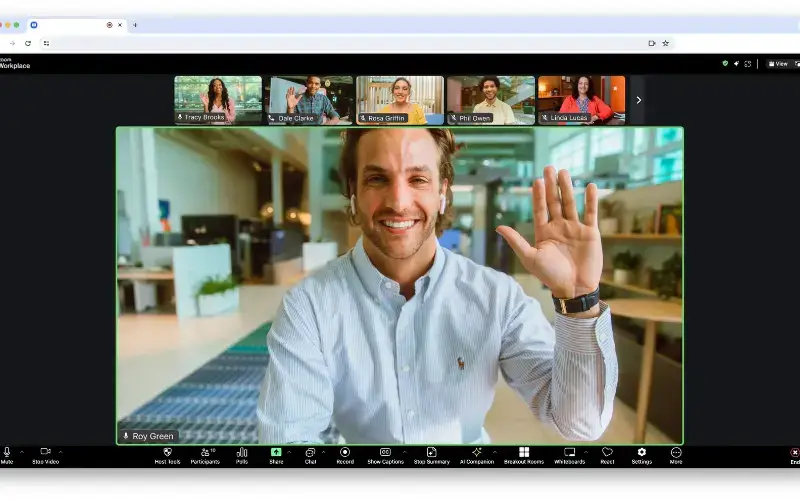
Zoom Events & Webinars is Zoom’s dedicated event product for planning, hosting, and managing online events with more features than a standard Zoom meeting.
It builds on a platform most attendees already know, which makes it easier to run events without adding a steep learning curve. While it works well for polished, speaker-led sessions, compared to a purpose-built platform like Remo, networking can feel limited when attendees need to move freely or form spontaneous small-group conversations.
Key Features
Zoom Events & Webinars focuses on structured virtual event delivery, combining familiar Zoom usability with added tools for larger, more managed online experiences.
- Dedicated expo floor for browsing exhibitor booths, sponsor chat, and partner connections.
- Custom registration pages with sign-up tracking and attendee access controls.
- Centralized lobby for agenda viewing, speaker bios, and session navigation.
- Built-in production tools for branded layouts, custom scenes, and session management.
- Performance tracking for attendance and key marketing metrics.
Pros
- Consistent performance with stable screen sharing, smooth transitions, and minimal lag.
- Ability to customize registration and ticketing options simplifies event management.
- Familiar interface for attendees, presenters, and organizers who already use Zoom.
Cons
- Not the best fit if you’re looking for high-energy, interactive events.
- There is a noticeable lack of visual customization and flexibility in the design.
Pricing and Free Trial
Zoom Events starts at $415.83 per month, billed annually, for 500 attendees. The plan requires Zoom Workplace Pro and includes multi-session virtual events. There is no free trial option for Zoom Events.
G2 Rating
Zoom Events & Webinars is rated 4.5 out of 5 on G2.
Best For
Zoom Events & Webinars is best for teams that already use Zoom and need a reliable platform for one-to-many webinars, town halls, or online sessions with limited attendee interaction.
3. Airmeet
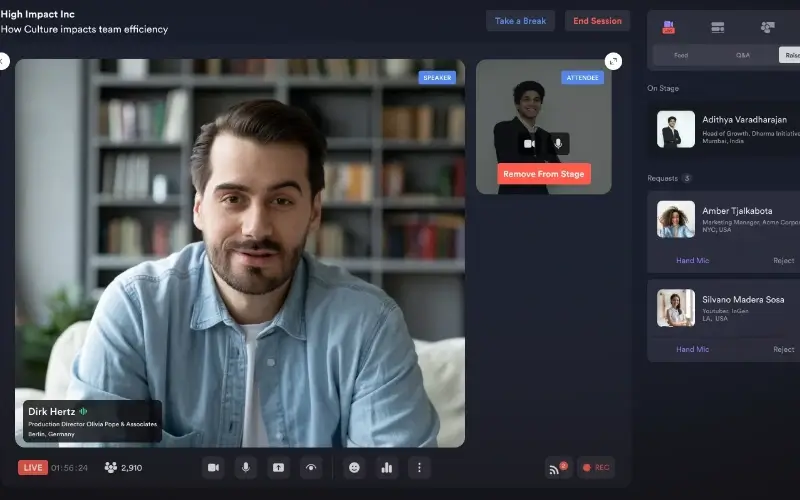
Airmeet is a virtual event platform designed for branded online events. It sits between basic webinar tools and large enterprise event platforms, offering more interactive features without feeling as heavy as a full enterprise event suite. It's a good fit for teams that want polished, professional events with built-in engagement tools and a relatively simple setup experience. However, because Airmeet tries to balance structured presentations with social interaction, its networking can feel a bit clinical, lacking the fluid, organic flow of an attendee-led virtual event platform, where attendees can freely float between virtual tables.
Key Features
Airmeet focuses on branded virtual events with a balance of presentation tools, networking, and sponsor engagement features.
- Automated, timed one-on-one speed networking.
- Support for multiple sessions, breakout rooms, and sponsor areas running within the same virtual event.
- Organizers can bring attendees onto the virtual stage to speak, share insights, or join panel discussions.
- Custom sponsor booths and branded event pages for showcasing content, capturing leads, and keeping the event experience consistent.
- Comprehensive event performance and engagement tracking via the "AirIntel" dashboard.
Pros
- Lets you customize the look and feel to match your organization.
- Syncs directly with HubSpot and Salesforce to streamline workflow.
- Manages large-scale meetings with a high number of attendees, up to a 100k.
Cons
- Mobile experience can be limited compared to the desktop version.
- Some advanced features are gated behind higher-tier plans.
Pricing and Free Trial
Event plans are quote-based, with managed events starting at $4,999 and agency options featuring attendee-based billing. You can get started with a free tier, and they offer demo options if you’re looking to explore the full suite of event features.
G2 Rating
Airmeet holds a strong 4.6 out of 5 stars on G2.
Best For
Airmeet is best for teams running community-driven events, corporate town halls, and multi-track conferences where the goal is to balance professional content with real social interaction.
4. vFairs
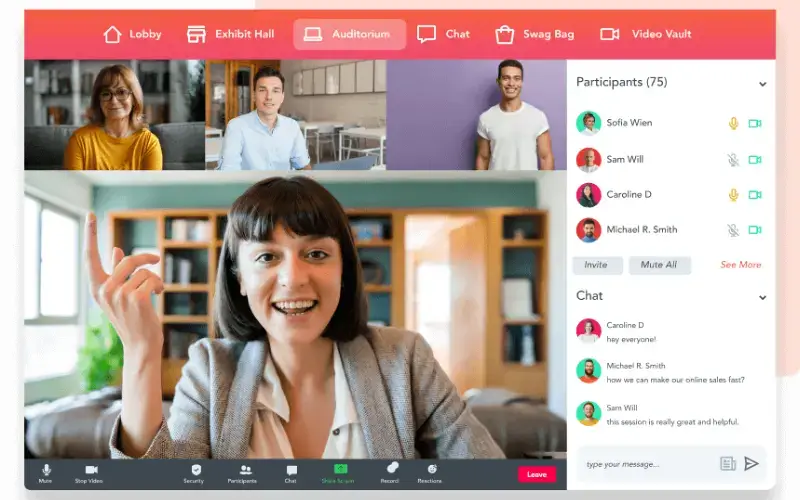
vFairs is a virtual and hybrid event platform known for its 3D digital event environments. Rather than feeling like a standard livestream, events on vFairs are designed to feel like dedicated online venues. This makes the platform a strong choice for high-stakes events where production value matters more than quick setup. However, that level of customization can also mean a longer configuration process compared to other virtual event platform alternatives.
Key Features
vFairs focuses on venue-style virtual and hybrid events, with features built around immersive spaces, exhibitor management, and detailed event analytics.
- Immersive 2D or 3D digital venues for trade shows.
- Interactive exhibitor booths with product demos, file sharing, and live chat.
- Self-service exhibitor portal for independent management of booth content and leads.
- Meeting scheduler for one-on-one hosted buyer meetings.
- Detailed booth analytics for tracking traffic, engagement, and chat activity.
Pros
- A dedicated, solution-oriented team for event support.
- Efficient systems for managing emails, agenda updates, and registrant messaging.
- Integrations are described as smooth by some reviewers.
Cons
- It might feel like overkill if you're just hosting a simple webinar or basic virtual conference.
- The 3D design can require more setup time and might need a little extra guidance for attendees.
Pricing and Free Trial
vFairs relies on custom pricing tailored to your event, so there is no publicly displayed pricing but some reviews mention pricing is relatively higher than other virtual event platforms. The best way to get started is to book a demo or product tour. There isn't a public self-serve free trial available.
G2 Rating
vFairs is rated 4.7 out of 5 on G2.
Best For
vFairs is best for virtual trade shows, expos, job fairs, recruitment fairs, buyer-seller events, and sponsor-heavy programs that need booths, exhibitor tools, and product showcases.
5. Goldcast
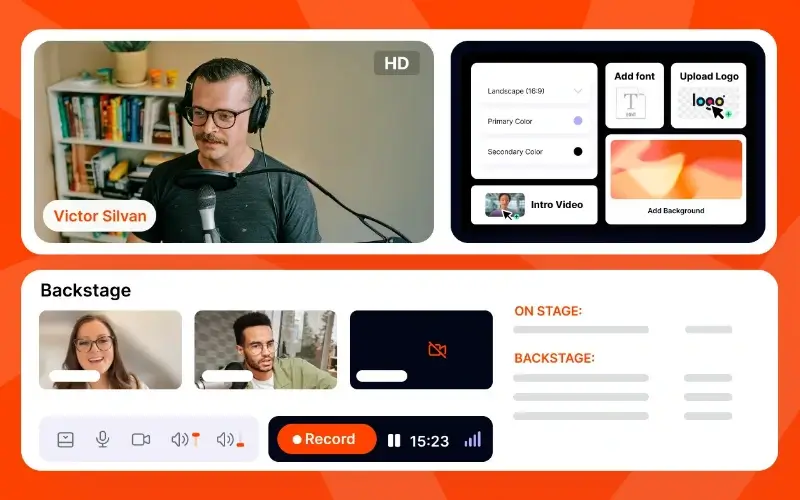
Goldcast is an AI-first video and event platform built for B2B teams. While Goldcast offers a strong virtual event experience, its real strength is what happens after the event. The platform is built for B2B teams that want to turn event content, attendee insights, and engagement data into campaign assets, follow-up opportunities, and pipeline activity.
Key Features
Goldcast’s features connect live event delivery with content repurposing, audience engagement, and pipeline tracking.
- Branded webinars for product launches, customer meetups, and demand generation.
- Multi-session event management with custom agendas, breakout rooms, and tracks.
- Built-in AI content lab for repurposing recordings into social clips, blogs, and video snippets.
- Netflix-style, branded video hubs for long-term on-demand audience engagement.
- Deep CRM integrations with Salesforce, HubSpot, Marketo, and Eloqua for automated pipeline tracking.
Pros
- The native integrations with major marketing automation tools are seamless.
- Capability to support a large volume of concurrent events.
- Consistently high praise from users regarding support and ease of use.
Cons
- Mobile experience is not optimized and needs improvement.
- Reports take an excessive amount of time to generate and frequently leave key questions unanswered.
Pricing and Free Trial
Goldcast uses a custom, quote-based pricing model and does not offer a free trial. Because it is positioned as an enterprise B2B marketing engine, it commands a significantly higher price point than other virtual event platforms.
G2 Rating
Goldcast has 4.7 out of 5 stars on G2.
Best For
Goldcast is best for B2B webinars, product launches, customer events, demand generation programs, and teams that want event content to support follow-up, nurture, and pipeline activity.
6. Cvent
.webp)
Cvent is an enterprise event management platform for virtual, hybrid, and in-person events. It's a strong fit for organizations running large or complex programs that require robust planning, reporting, and governance features but the tradeoff is complexity, cost, and a heavier implementation experience. The platform focuses less on creating the simplest event experience and more on helping teams manage everything happening behind the scenes.
Key Features
Cvent’s features support more detailed setup, attendee management, and performance tracking at scale.
- Customizable registration paths, branded event sites, and complex payment flows.
- Centralized Attendee Hub with mobile app, agendas, networking, and sponsor content.
- Detailed reporting for ticket sales, engagement metrics, and event performance.
- Enterprise-grade integrations with CRM and marketing platforms via API or SSO.
- Intuitive drag-and-drop builders for professional emails and websites.
Pros
- Niche event management features that help simplify large, complex agendas.
- Comprehensive help portal that ensures projects remain on track.
- Real-time updates and event communications.
Cons
- Some users have reported clunky check-in workflows.
- The interface is quite feature-heavy, which can make it feel cluttered compared to simpler, newer platforms.
Pricing and Free Trial
Cvent uses unpublicized custom contracts. For simpler events, they offer a pay-as-you-go tier (PayGo) that charges a flat fee per registrant instead of a contract. While there is no live free trial, they provide a restricted sandbox environment to build and preview test pages for free.
G2 Rating
Cvent is rated 4.3 out of 5 on G2.
Best For
Cvent is best for large enterprises, associations, and professional event teams that need a deep, reliable, and fully integrated system to manage complex event programs.
7. RingCentral Events
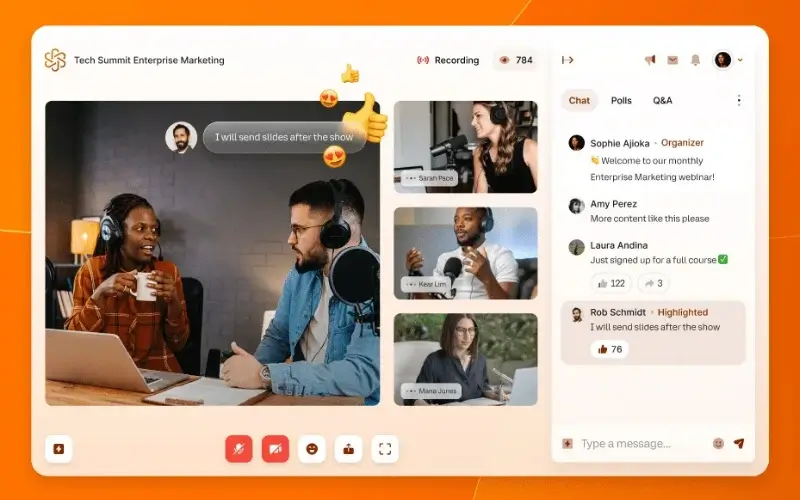
RingCentral Events focuses on helping teams run polished virtual and hybrid events with multiple sessions, stages, and content tracks. It is designed for organizations managing larger or recurring event programs that need structured session delivery, branded event spaces, attendee engagement, and post-event content access. That makes it useful for multi-session events, but it may feel heavier than necessary for teams that only need a simple, lightweight virtual event setup.
Key Features
RingCentral Events is built for teams managing more structured event programs. Its features support branded delivery, multi-session content, and post-event reuse.
- Embedded production tools for polished, professional-looking virtual sessions.
- Fully branded event spaces with custom domains for consistent brand identity.
- Persistent content hub for hosting on-demand sessions and maximizing ROI.
- Automatic AI content repurposing for highlights, social posts, emails, and blog content.
- Centralized dashboard for tracking engagement and performance across event portfolios.
Pros
- Automatic session recordings, allowing attendees to catch up on missed content.
- Ability to host parallel sessions for larger multi-track events.
- Cross-event analytics are useful for tracking performance across multiple events.
Cons
- A rigid setup that mandates speakers stream from a backstage area, adding unnecessary complexity compared to standard session workflows.
- Less focused on open networking and table-style conversations.
Pricing and Free Trial
RingCentral Events offers a transparent, pay-per-organizer pricing model starting at $99 per month with unlimited registrations and events. RingCentral offers a 30-day free trial with most core functionality and limited registrations.
G2 Rating
RingCentral Events has a 4.5 out of 5-star rating on G2.
Best For
RingCentral Events is best for large virtual conferences with multiple sessions or speakers that need production tools, attendee engagement, content hosting, and cross-event analytics.
8. Gather
.webp)
Gather, formerly known as Gather.town, is a pixel-art virtual event and office platform built around avatar-based movement. Its game-like design and pixel-style environment lets attendees walk through a digital venue, approach different areas, and join conversations as they move, similar to Remo’s spatial networking experience. This makes the experience feel more playful, and exploratory than a standard video conferencing tool like Zoom.
Key Features
Gather is built around movement and informal interaction. Its features suit social events, team activities, and exploratory virtual spaces.
- Immersive proximity-based audio and video for natural, spatial interaction.
- Includes native interactive objects like poker, Tetris, and social arcade games scattered around the map, making it easy for internal teams to interact.
- Spotlight broadcasting for keynotes and guided sessions.
- Integrated interactive objects, links, and documents within the space.
- Centralized landing pages and info boards for schedules and navigation.
Pros
- Transparent self-serve pricing compared with many quote-only platforms
- A user-friendly design that makes remote collaboration feel natural and accessible.
- Keeps project context, schedules, and action items in one accessible location, eliminating the need to toggle between different tools.
Cons
- Its game-like interface may feel less professional for formal corporate events or high-brand-control experiences.
- Performance can lag on slower devices, which may affect usability for some attendees.
Pricing and Free Trial
Gather 2.0 uses a subscription model starting at $15 per active user per month, with a 30-day free trial available. For event organizers, this means pricing may depend on how many people need ongoing access to the space, so it is worth checking how your expected attendees, hosts, and recurring users are counted before choosing a plan.
G2 Rating
Gather has a 4.8 out of 5 G2 rating.
Best For
Gather is best for remote-first teams, internal company hackathons, virtual happy hours, and tight-knit community spaces where movement and discovery are central to the experience.
9. ON24
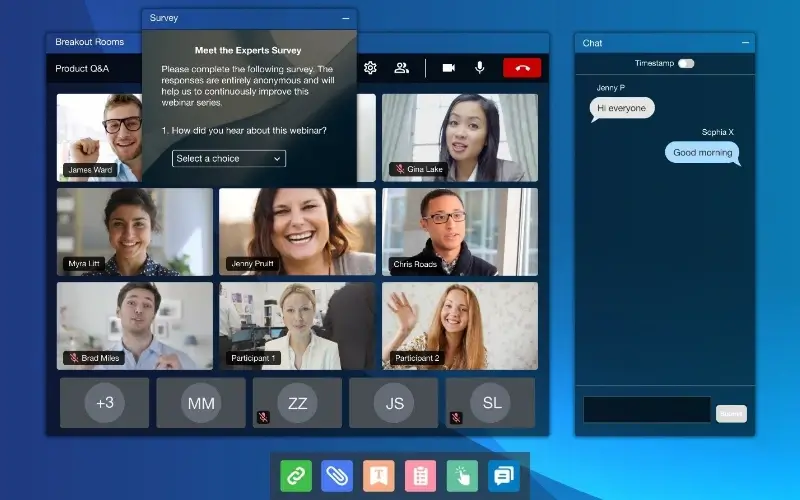
ON24 is a webinar and digital engagement platform for live, simulive, and on-demand experiences. Its biggest strength is data. Instead of prioritizing networking or virtual event experiences, ON24 focuses on helping teams understand how attendees engage with content and turn those insights into better marketing and sales follow-up.
Key Features
ON24’s tools are designed to capture how attendees interact with content and turn that activity into useful marketing and sales signals.
- Branded digital spaces for auditoriums, expo halls, networking lounges, and resource libraries.
- Interactive engagement widgets, including polls, surveys, Q&A, and CTAs.
- ON24 AI Content Engine for content personalization, highlights, and promotional copy.
- Always-on, branded video hubs for on-demand content exploration.
- Seamless synchronization of engagement and lead data with major CRM and marketing platforms.
Pros
- Industry-leading analytics that track individual-level buyer intent and engagement.
- Native, robust integrations with major marketing automation and CRM platforms.
- Strong AI-driven tools for repurposing content and scaling outreach.
Cons
- It is not designed for two-way interaction or attendee-led networking, which may be a drawback if engagement is your primary goal.
- Restricted user capacity; no flexibility to expand user limits beyond the current constraints.
Pricing and Free Trial
ON24 uses custom, quote-based pricing across its service tiers (Essentials, Standard, and Advanced). You will need to contact their sales team for a quote tailored to your specific needs. There is no public self-serve free trial either.
G2 Rating
ON24 has a 4.3 out of 5-star rating on G2.
Best For
ON24 is best for enterprise-level B2B webinars, demand generation programs, and digital engagement campaigns where the primary goal is to generate qualified leads and drive revenue.
10. Microsoft Teams
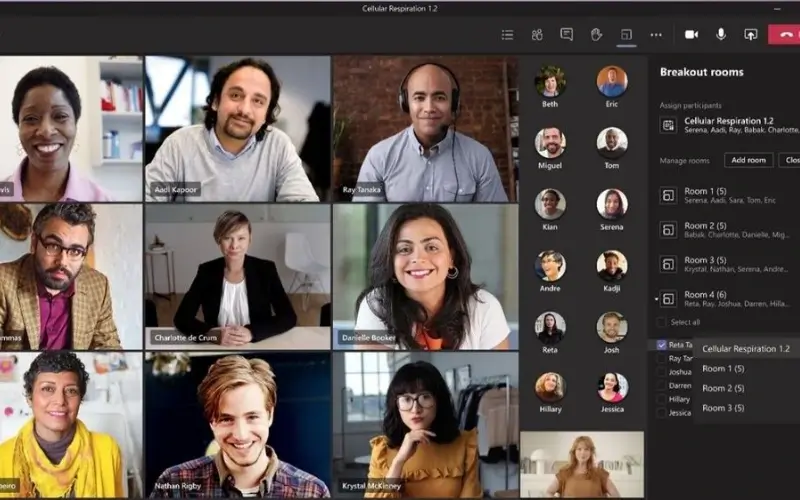
Microsoft Teams is a collaboration and video meeting platform with dedicated webinar and town hall features built into the Microsoft 365 ecosystem, making it a robust option for internal virtual events more than external conferences. It works best when companies need a familiar way to run employee webinars, trainings, leadership updates, and broadcast-style sessions without adding another tool to their tech stack.
Key Features
Microsoft Teams keeps virtual event delivery close to everyday workplace communication, with features for broadcasts, training sessions, and organized internal updates.
- Copilot AI assistant generates instant meeting summaries, action items, and follow-up notes using natural language queries.
- Together Mode uses AI to extract everyone's silhouettes and seat them side-by-side in a shared virtual auditorium.
- Generates real-time, speaker-attributed transcripts alongside your recordings, with options to capture text-only to save cloud storage.
- Breakout rooms for organizers to split large meetings into smaller sub-groups, with the ability to pre-assign participants via CSV files.
- Microsoft loop components such as live, interactive tables and task lists embedded in chats that anyone can edit inline in real time.
Pros
- Seamless synchronization with Outlook, Teams, and the full Microsoft 365 suite.
- Browser-based access with no downloads required.
- Scalability for large audiences via Attendee Capacity Packs.
Cons
- Weaker branding and event-style analytics than dedicated event tools
- Inviting and managing guest users outside your organization is notoriously clunky, often requiring external clients to constantly switch whole tenant profiles to see messages.
Pricing and Free Trial
Pricing starts at $4.00 per user/month for basic internal events, but ultimately varies by region and plan; events with 300+ attendees may require additional capacity add-ons. Microsoft offers a free trial path through Microsoft 365 plans.
G2 Rating
Microsoft Teams Webinars has a 4.6 out of 5 G2 rating.
Best For
Microsoft Teams is best for companies already using Microsoft 365 that need internal webinars, town halls, trainings, leadership updates, or simple company-wide virtual events.
Each virtual event platform brings something different to the table, from simple webinar delivery to advanced expos, analytics, and networking spaces. The right choice depends on your event format, audience size, and how much interaction you want attendees to have.
Virtual Event Platform vs Webinar Tool vs Video Conferencing Tool
While virtual event platforms, webinar tools, and video conferencing tools often get grouped together, they serve fundamentally different purposes. Choosing the right tool depends entirely on the attendee journey, specifically, whether your event requires passive content consumption, active participation, or a fully immersive digital environment.
How to Choose
The simplest way to decide is to evaluate the attendee's desired experience:
- Choose a Video Conferencing Tool if your event is a simple meeting, internal call, team training, or small session where people mainly need to talk, present, and share screens.
- Choose a Webinar Tool if your primary goal is content delivery from a speaker to an audience.
- Choose a Virtual Event Platform if you need an environment where attendees can navigate their own experience, visit booths, join breakout rooms, and engage in meaningful peer-to-peer networking.
Selecting the correct category is critical to your event's success. Using a webinar tool for an expo-style event often creates a passive experience that fails to build real connection. Similarly, using a video conferencing tool for a multi-session conference may lack the structure and professionalism needed to manage high attendee volume effectively. A virtual event platform provides the necessary flexibility to create a digital venue rather than just another video call.
Should You Use an All-in-One Virtual Event Platform or a DIY Tech Stack?
Deciding between an integrated platform and a patchwork of tools depends on the scale and complexity of your event.
The DIY Tech Stack
A DIY tech stack means connecting separate tools yourself. You can build an event by stitching together various tools (e.g., Zoom for video, Eventbrite for registration, Mailchimp for emails).
- Best for: Small, low-stakes events, free webinars, or simple internal meetings, where the goal is mainly content delivery.
- The Trade-off: The attendee journey often feels fragmented, and your team faces significant manual work to bridge data between separate applications.
The All-in-One Platform
An all-in-one platform, like Remo, centralizes the entire experience, registration, access control, engagement, and reporting, into one system.
- Best for: Multi-session conferences, paid events, career fairs, and sponsor-heavy programs, and events that need a polished attendee experience.
- The Benefit: Offers a seamless attendee experience, reliable post-event analytics, and deep CRM integrations that save your team hours of administrative effort.
If your event is focused on simple content delivery, a DIY tech stack can work. If your event needs networking, sponsors, gated access, analytics, CRM integrations, or a smoother attendee journey, an all-in-one platform is the safer choice.
Choose the Right Virtual Event Platform
Every event is different, so the right platform ultimately comes down to what you want attendees to experience. Some events only need simple video and registration, while others need networking, sponsor visibility, multiple sessions, analytics, and a more interactive attendee experience.
If networking, movement, and real conversation matter most, Remo stands out for creating virtual events that feel more human and engaging.
Want to make your next virtual event more interactive? Book a demo to see how Remo can help you host engaging conferences, workshops, career fairs, and networking events.
Frequently Asked Questions about Best Virtual Event Platform
1. What are the best virtual event platforms?
Some of the best virtual event platforms include Remo, Zoom Events, Airmeet, vFairs, Cvent, RingCentral Events, Gather, Goldcast, ON24, and Microsoft Teams.
2. Are there free virtual event platforms?
Yes, some platforms offer free trials, free tiers, or limited free plans. These usually work best for testing or small events.
3. What is the best virtual event platform with avatars?
Remo is the best choice if you want 2D profile avatars that move between virtual tables for natural, spontaneous group conversations. If you prefer pixel-art cartoon avatars that physically walk around a map to discover people and spaces, Gather is a strong alternative.
Aniqa Iqbal
Aniqa is a content writer at Remo, where she merges her love for storytelling from movies and TV shows with her passion for creating compelling content. With a knack for blending pop culture references and relatable narratives, Aniqa crafts content that informs and resonates deeply with readers. She aims to strike a chord with her audience, fostering genuine connections through words that inspire, engage, and entertain. When she's not writing, Aniqa can be found binge-watching her favorite shows, always on the lookout for the next story to tell.