9 Best Webinar Platforms for Every Use Case in 2026


The best webinar platforms in 2026 include Remo for interactive webinars, Zoom Webinars for large-scale broadcasts, Livestorm for B2B lead generation, Demio for easy setup, and eWebinar for automated webinars. Which one is right for you depends on your audience size, webinar format, engagement needs, marketing workflow, and budget.
A webinar platform can look great on a feature checklist and still be the wrong fit once you actually start using it. A team running a 10,000-person one-way broadcast has very different needs from one trying to get 100 attendees talking. A marketing team running a lead generation webinar will care about features and capabilities that may not matter at all for internal webinars.
This guide covers the 9 leading webinar platforms of 2026, including what each does best, standout features, pricing, G2 ratings, and the limitations worth knowing about.
{{table-of-contents}}
The Best Webinar Platforms at a Glance
The best webinar platforms in 2026 include:
Best Webinar Platforms Comparison
Feature availability alone doesn’t tell you which webinar platform is the best fit. This comparison focuses on practical buying criteria, including pricing, audience capacity, delivery formats, attendee access, interaction, and integrations.
Pricing, plan limits, feature availability, attendee capacity, free trials, and G2 ratings were checked against current vendor pages, help documentation, and review profiles in October 2026.
How We Evaluated the Best Webinar Platforms
For this list, we looked at how each platform supports the full webinar experience, from registration and live delivery through engagement, follow-up, analytics, and on-demand content.
We compared each platform based on:
- Webinar formats: Whether it supports live, Simulive, automated, on-demand, or multiple formats in one platform.
- Audience engagement: The ways attendees can participate, including polls, Q&A, chat, CTAs, quizzes, breakout discussions, and peer-to-peer interaction.
- Ease of use: How straightforward the platform is to set up, manage, and learn, especially for teams without dedicated event staff.
- Audience capacity: Maximum attendee limits, how capacity changes by plan, and whether higher volumes affect pricing or feature availability.
- Registration and marketing: Event registration custom questions, email invites, reminders, attribution, and other pre-event tools.
- Analytics and reporting: The depth of attendance, engagement, behavioral, and lead-level data available after an event.
- Integrations: Native CRM and marketing integrations, as well as what webinar data can actually be passed between systems.
- Post-webinar capabilities: Replays, on-demand hosting, follow-up, content editing, repurposing, and ongoing engagement tracking.
- Pricing: Starting price, attendee limits, feature gating, overage charges, add-ons, and other costs that affect the real price of running webinars.
- Customer feedback: Current G2 ratings and recurring themes in user reviews, particularly around usability, support, reliability, and limitations.
The 9 Best Webinar Platforms in 2026
We compared 9 leading webinar platforms across features, pricing, use cases, and user feedback. Here’s how they stack up in 2026.
1. Remo — Best for Interactive Webinars
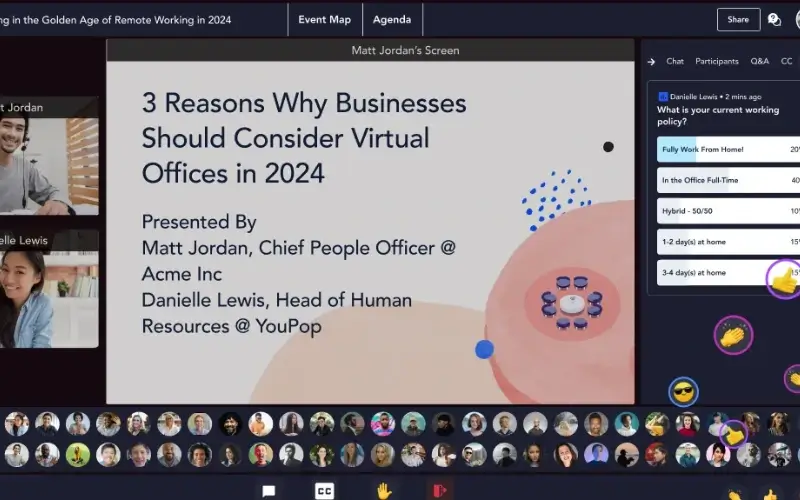
Remo is a browser-based webinar platform that combines structured presentations with more natural, face-to-face interaction.
In Presentation Mode, hosts can speak to the full audience and use tools like polls, quizzes, and clickable CTAs. In Conversation Mode, attendees move into smaller table discussions where they can talk directly with one another. Hosts can switch between these two modes with one click inside the same event, so a webinar can move from a presentation to small-group discussion and then back to a closing call to action without anyone opening a new link.
Where Remo stands out is in how much more active the audience can be throughout the webinar. Remo goes beyond standard webinar interactions like chat and Q&A by giving hosts more direct ways to involve attendees, such as bringing attendees on stage or moving them into free-flowing small-group breakout discussions. This makes it a good fit for workshops, training sessions, or lead-generation webinars where participants are meant to contribute.
Standout features:
- Google Slides integration: Present and control Google Slides directly on the Remo stage while still keeping chat, Q&A, polls, and other event interactions in view, reducing the need to switch between tabs while presenting.
- More ways to involve attendees directly: Alongside polls, Q&A, and live chat, hosts can run quizzes, invite attendees onto the virtual stage, and move participants into face-to-face virtual table conversations for more active participation.
- Presentation Mode CTAs: Launch clickable banners or center-screen pop-ups during a presentation to promote offers, demos, resources, discounts, or next steps while attendees are still engaged.
- Automated registration workflow: Remo automatically creates a registration page for the event and lets hosts manage invitations, confirmation emails, scheduled reminders, and up to 10 custom registration questions from the same platform.
Pros:
- Gives attendees a more active role than they typically get in presentation-first webinar platforms.
- Interaction can happen between attendees as well as with the host. Participants can talk directly with one another in smaller discussions, rather than only responding through chat, polls, or questions directed at the presenter.
- Remo customers frequently highlight responsive, human support that helps with both troubleshooting and event planning. Having the same account manager involved throughout the event cycle can also make coordination easier because teams do not have to repeatedly re-explain their setup or goals.
Cons:
- Remo is strongest for live and Simulive-style webinars, but teams that rely on automated evergreen sessions or hosted on-demand replays would need to use another tool alongside it.
- Its native integration ecosystem is more limited than some webinar-focused marketing platforms, although integrations are available through Zapier, Pabbly, and API access.
G2 rating: Remo has a rating of 4.5/5 based on 323 reviews.
Pricing / free trial: Remo pricing plans start at $299 per month, while one-time events start at $699. Remo also offers a 14-day free trial.
Best for: Workshops, training, and customer webinars with up to 1,000 attendees where discussion and peer interaction are an important part of the experience.
.webp)
2. Zoom Webinars — Best for Large-Scale Webinars
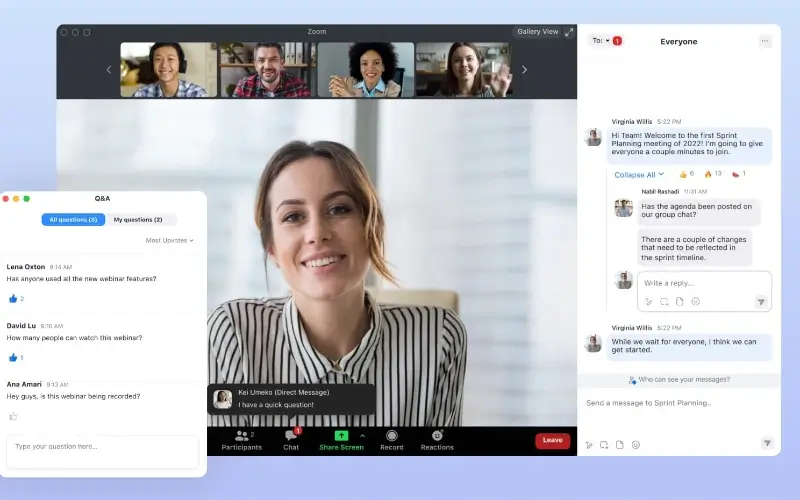
Zoom Webinars is a widely used webinar platform that builds on the Zoom environment many teams already use. It adapts that familiar setup for structured, presentation-led events with registration, audience controls, production tools, and post-event reporting. That makes it easier to add webinars without introducing an entirely new system for hosts or attendees to learn.
Its strength is scale. For large one-to-many broadcasts, Zoom’s mature video infrastructure, broad audience capacity, and controls for managing speakers, attendees, Q&A, and presentation flow make it a practical choice for organizations running large, structured sessions.
Standout features:
- Production Studio: Gives hosts more control over how the webinar looks on screen, with customizable layouts, branded backgrounds, speaker arrangements, and visual elements that make larger broadcasts feel more polished.
- Backstage: Gives hosts and panelists a private space to prepare, coordinate, and manage speaker handoffs before appearing live in front of attendees.
- Simulive webinars: Lets teams schedule pre-recorded content to run automatically, while still giving hosts the option to stay involved through live chat and Q&A or transition into a live segment afterward.
- Webinar analytics: Tracks registration, attendance, engagement, poll responses, and Q&A activity so teams can see how people participated and how individual webinars performed.
Pros:
- Zoom Webinars can support up to 100,000 attendees on standard enterprise webinar configurations, with specialized options available for even larger events.
- Because Zoom is already widely used, many hosts and attendees know how to join, mute, use chat, and navigate the interface, which can reduce onboarding questions and event-day support.
Cons:
- Teams looking to create a highly distinctive branded webinar experience may find the customization options restrictive.
- The experience still revolves largely around presenters broadcasting to an audience, with fewer options for organic attendee-to-attendee interaction.
G2 rating: It has a rating of 4.5/5 based on 412 reviews.
Pricing / free trial: Zoom Webinars starts at $89 per month for up to 300 attendees, while Webinars Plus starts at $99 per month for up to 100 attendees and adds AI, on-demand video, and more advanced production tools. Both plans require Zoom Workplace Pro, so teams not already using it should factor that additional subscription into the total cost.
Best for: Organizations broadcasting presentation-led webinars to thousands of attendees that need predictable delivery and a familiar user experience.
3. Demio — Best for Easy Webinar Setup
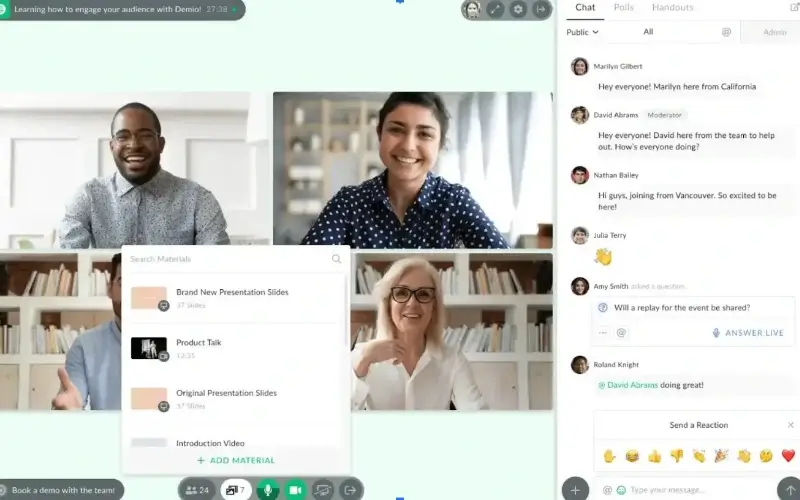
Demio is a browser-based webinar platform designed to make running live and automated marketing webinars feel straightforward rather than technical. The experience is intentionally streamlined, so hosts can move from setup to registration to delivery without dealing with a complicated event-production workflow.
That simplicity makes Demio a good fit for teams that don't want webinar setup to become a project of its own. You don’t need to be a webinar specialist to navigate the platform, and the relatively simple interface helps smaller teams get polished webinars live without a lot of setup time or production overhead.
Standout features:
- Featured Actions: Add clickable CTAs during the webinar for things like demo bookings, offers, or next steps, and track who actually clicks them.
- Engagement analytics: See more than just who showed up. Demio tracks things like poll responses, chat activity, handout downloads, CTA clicks, and whether attendees stayed focused on the webinar tab.
- Built-in registration and follow-up: Create registration pages, collect attendee details, and manage reminder and follow-up emails without needing a separate tool.
- Live, automated, and on-demand webinars: Run different webinar formats from the same platform, although automated and on-demand sessions are only available on the Growth plan and above.
Pros:
- Demio’s clean interface and guided workflow make it relatively quick for new hosts to learn and set up webinars.
- Users highlight Demio’s reporting and attendee data as easy to understand and practical for improving future webinars, without requiring a more advanced analytics platform.
- Hosts can set up polls, handouts, and Featured Actions before the webinar begins, reducing the amount of live event setup they need to manage once they are on air.
Cons:
- Branding customization is relatively limited, particularly around registration-page design and email customization, which may feel restrictive for teams that want tighter control over the attendee experience.
- Demio’s lower tiers can feel restrictive as you scale: Starter is capped at 50 attendees, while Growth jumps through set room sizes of 150, 500, 1,000, and 3,000. Automated and on-demand webinars also require Growth or higher, so teams may need to upgrade sooner than expected even if their audience is still relatively small.
G2 rating: Demio has a rating of 4.6/5 based on 172 reviews.
Pricing / free trial: Demio’s Starter plan begins at $63 per month for 50 attendees on monthly billing. Automated and on-demand webinars require the Growth plan or higher, which also unlocks larger room sizes and additional branding features. A 14-day free trial is available with Growth-plan features, limited to 20 attendees and one-hour sessions.
Best for: Marketing teams that want to get professional webinars live quickly without spending a lot of time learning, configuring, or managing the platform.
4. GoTo Webinar — Best for Corporate Training
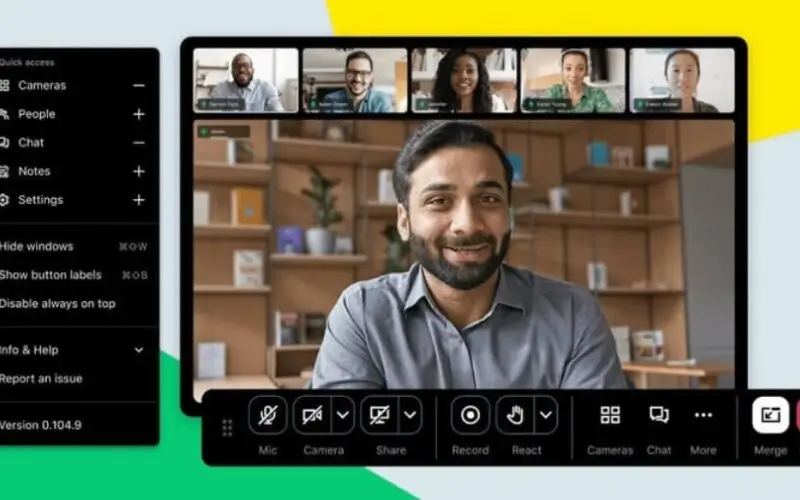
GoTo Webinar is an established platform built for structured, presenter-led webinars used in business, training, and professional education. It supports live, recorded, and Simulive sessions, making it well suited to organizations that run repeatable webinar programs rather than one-off events.
It makes particular sense when webinars are something your organization runs regularly rather than occasionally. Recurring session support, reporting, and administrative controls help teams standardize training and education programs across multiple events.
Standout features:
- Simulive delivery: Use pre-recorded presentations within scheduled webinar experiences, helping teams deliver consistent training without requiring presenters to repeat the same material live.
- Training-friendly engagement tools: Polls and Q&A give trainers simple ways to check understanding and break up longer presenter-led sessions.
- Certificates: Create branded certificates for attendees, with options to customize elements such as the logo, colors, signature, and completion details. GoTo is also rolling out conditional certificates based on attendance duration.
- Breakout rooms: Split attendees into smaller groups for discussion, exercises, or collaborative learning during a larger training session.
Pros:
- GoTo Webinar powers more than 2.8 million professional events each year, giving it a long track record across business webinars, training, and other structured online sessions.
- Teams running regular training or education programs can reuse the same webinar structure instead of rebuilding registration, settings, and session details for every event.
- Reporting and administrative features give training teams a practical way to keep track of participation.
Cons:
- The interface can feel dated compared with newer webinar platforms that place more emphasis on modern design and streamlined workflows.
- Breakout rooms are not included on the entry-level Reach plan and require Elevate or above, which matters for training teams that see small-group discussion as a core part of the experience.
G2 rating: GoTo Webinar has a rating of 4.2/5 based on 804 reviews.
Pricing / free trial: GoTo Webinar’s Reach plan starts at $69 per month and supports up to 500 participants. Elevate starts at $129 per month and increases capacity to 1,000 participants, while Complete uses custom pricing and supports up to 3,000 participants, with live streaming available for larger audiences. A free trial is available.
Best for: Companies running repeatable employee training, professional education, or other structured webinar programs where consistency and administration matter.
5. Livestorm — Best for B2B Webinar Lead Generation
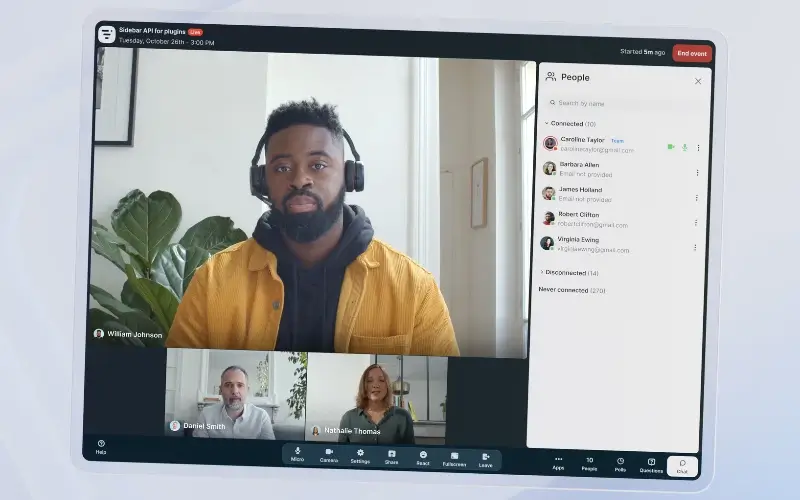
For B2B teams, Livestorm is strongest when the webinar is part of a wider lead-generation and follow-up process rather than a one-off live event. It helps teams understand where registrants came from, capture lead data, and pass webinar engagement into CRM and marketing workflows so sales and marketing teams have more context after the session ends.
Livestorm can support webinars for up to 3,000 attendees on higher-tier plans, making it suitable for everything from smaller product demos to larger demand-generation events. It also supports live, automated, and on-demand webinars, giving teams flexibility in how they use webinar content across the funnel.
Standout features:
- Custom registration pages and forms: Collect the lead information your team needs using customizable registration fields rather than relying on a fixed sign-up form.
- UTM tracking and attribution: Track which campaigns and channels are responsible for webinar registrations, making the event easier to connect to broader marketing performance.
- CRM and marketing integrations: Sync webinar registration and engagement data with platforms such as HubSpot and Salesforce (Enterprise plan only) to support lead management and follow-up.
- Contact profiles: Build a richer picture of each registrant by keeping their contact details, registration information, attendance, and engagement activity in one place, making it easier to identify and follow up with higher-intent leads.
Pros:
- Treats the webinar as part of a larger B2B marketing journey rather than an isolated live session.
- Webinar content such as recordings can be reused as on-demand content, helping teams extend the value of a webinar beyond the original audience and continue generating engagement after the session ends.
- CRM connections and engagement data give marketing teams more context for follow-up than a simple attended/didn't-attend status.
Cons:
- The Pro plan limits individual sessions to 4 hours, which may be restrictive for longer virtual events or extended training sessions.
- If visual customization is a priority, other platforms give you more freedom to shape the attendee experience.
G2 rating: Livestorm has a rating of 4.4/5 based on approximately 1,740 reviews.
Pricing / free trial: Livestorm’s Pro plan starts at $3.00 per attendee credit. One credit is used each time an attendee joins a live session, replay, or on-demand session; if the same person attends two different sessions, they use two credits. If you run out of credits, new attendees cannot join or watch sessions until you move to a higher yearly tier. Livestorm offers a free-forever plan for small test events, supporting up to 30 attendees with sessions limited to 20 minutes.
Best for: B2B marketing teams running recurring demand-generation and lead-generation webinars.
6. eWebinar — Best for Automated Webinars
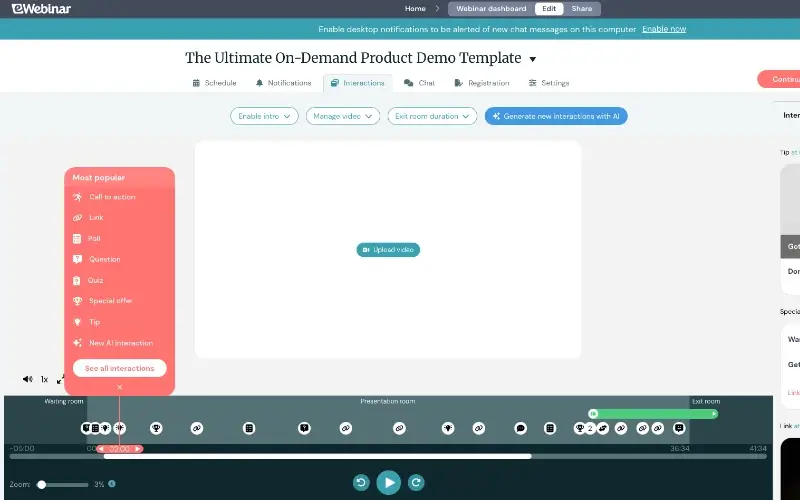
eWebinar is built around automated webinars from the ground up, rather than treating automation as an add-on to a primarily live webinar platform. Teams can turn pre-recorded presentations into sessions that run on demand, on recurring schedules, or through just-in-time delivery, with interactive elements and optional live chat layered on top.
That makes it especially useful for content your team finds itself presenting again and again. Product demos, onboarding sessions, training, and evergreen presentations can keep running without requiring someone to show up and deliver the same material live every time.
Standout features:
- Recurring sessions: Schedule the same automated webinar to run at set times, giving registrants multiple session options without someone having to present it live each time.
- Interactive pre-recorded sessions: Add polls, questions, tips, and clickable offers at specific points in the recording to make automated webinars feel more active.
- Live chat during automated webinars: Team members can respond to attendees in real time while the pre-recorded presentation continues automatically.
- Attendee analytics: Track registrations, attendance, viewing behavior, and interactions to understand how people engage with automated sessions.
Pros:
- Flexible scheduling gives attendees more ways to join. Teams can offer recurring sessions for planned attendance or just-in-time webinars for people who want to watch almost immediately.
- Automated scheduling allows sessions to run across different time zones and outside normal working hours.
- Automates more than just webinar delivery. Reminder emails, attendee nudges, and post-webinar follow-up can also be handled automatically, reducing the ongoing workload for the team.
Cons:
- No traditional live-presenter webinar mode. eWebinar is designed around pre-recorded sessions. Hosts can respond through live chat, but teams that regularly need fully live presentations will need another platform alongside it.
- eWebinar counts registrations rather than actual attendance toward your monthly limit, so no-shows still use capacity. If you reach that limit, new people cannot register until the next billing cycle or until you add more registrant capacity.
G2 rating: It is rated 4.3/5 based on 16 reviews. Although the number of G2 reviews is considerably lower than for most other platforms in this comparison.
Pricing / free trial: eWebinar starts at $99 per month for Level 1, which includes 1 active eWebinar and 1,000 registrants per month. Level 2 costs $199 per month for up to 5 active eWebinars and 3,000 monthly registrants, while Level 3 costs $299 per month for up to 15 active eWebinars and 5,000 monthly registrants. All three levels include the standard feature set, unlimited recurring sessions, and unlimited team members. Enterprise pricing is custom, and a 14-day free trial is available.
Best for: Repetitive webinars such as product demos, customer onboarding, training, and evergreen presentations that don't need a presenter to deliver them live every time.
7. BigMarker — Best for Highly Customizable Webinars
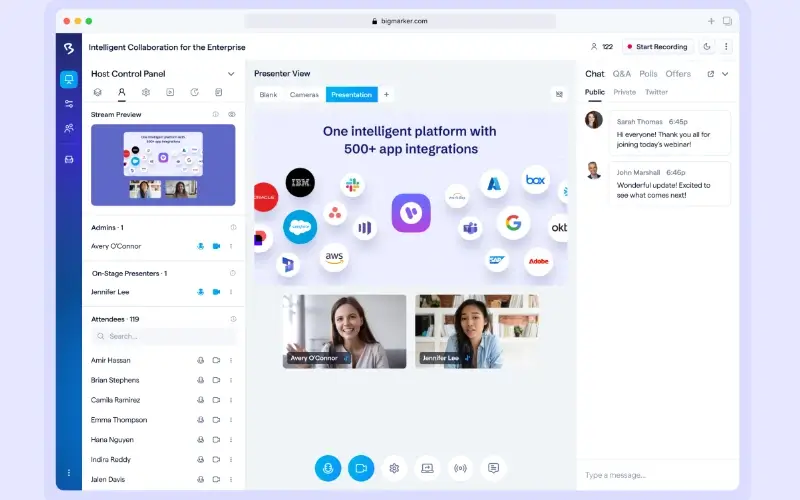
BigMarker is built for marketing teams that want more control over how their webinars look, feel, and operate. Rather than working within a mostly fixed event template, teams can shape the registration journey, branding, production setup, audience experience, and supporting workflows around a specific campaign or brand.
That flexibility is the main draw. It is especially useful for marketers running webinars as part of larger demand-generation or customer-engagement programs, where the event needs to reflect the brand closely and fit into a more complex marketing workflow.
Standout features:
- Custom registration experiences: Customize registration-page layouts, colors, content blocks, form fields, and confirmation messaging. BigMarker also supports different registration flows for different audiences, so teams can tailor the sign-up experience based on things like audience type, location, or referral source.
- Branded emails and attendee communications: Customize invitation, confirmation, and reminder emails with your own logo, colors, images, button styling, presenter details, and custom templates so the pre-event experience stays on brand.
- Custom webinar room and live layout: Change the webinar room’s logo, colors, backgrounds, interactive panels, and other visual elements. On Enterprise plans, Studio Scenes also lets teams pre-build and switch between different live layouts with elements like lower thirds, overlays, logos, and backgrounds.
- Configurable marketing workflows: BigMarker can connect registration and webinar data with CRM and marketing automation systems, while letting teams tailor what information is collected and how different audiences move through registration and follow-up.
Pros:
- Supports multiple webinar formats in one platform such as live, Simulive, evergreen, on-demand, and recurring webinars without needing separate tools for different delivery formats.
- BigMarker also offers virtual and hybrid event packages, so organizations that run both webinars and larger digital events can stay within the same broader platform ecosystem.
- BigMarker’s Basic webcast plan supports up to 1,000 live attendees, while higher tiers increase that capacity substantially
Cons:
- Many of BigMarker’s deeper customization options, including more advanced branding, embedded experiences, and production controls, are reserved for its highest Enterprise tier, so teams on lower plans may not get the full flexibility the platform is known for.
- All that flexibility comes with more to configure, so BigMarker can take longer to set up and learn than simpler webinar platforms.
G2 rating: BigMarker has a rating of 4.7/5 based on approximately 444 reviews.
Pricing / free trial: BigMarker uses custom, quote-based pricing across its main webinar plans. Basic and Professional include core webinar and production capabilities, but many of the platform’s deeper customization options, including custom audience experiences, embeddable registration and webinar rooms, and Studio Scenes, are reserved for the Enterprise tier.
Best for: Marketing teams running branded webinar programs that need more control, customization, and audience capacity than typical SMB webinar platforms offer.
8. ON24 — Best for Enterprise Webinar Analytics
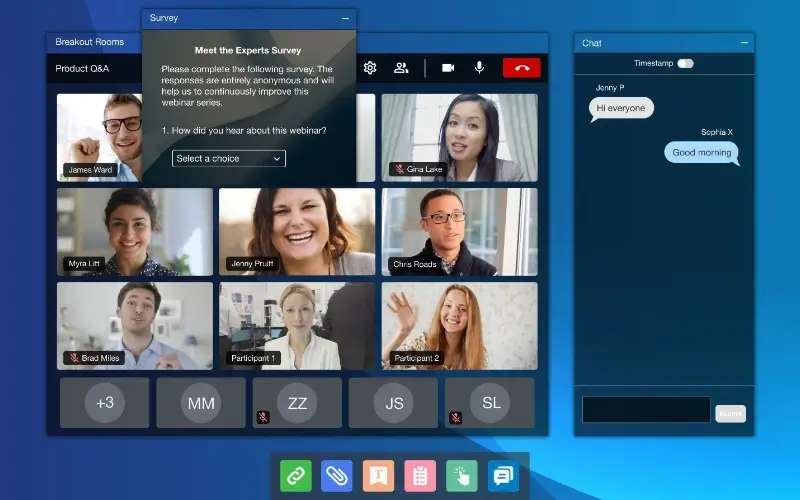
ON24 is an enterprise webinar and digital engagement platform built for marketing teams that want to understand what attendees actually do, not just whether they showed up. It tracks behaviors such as viewing time, poll responses, Q&A activity, content downloads, CTA clicks, and other interactions, then turns those signals into attendee-level engagement profiles and scores.
In April 2026, Cvent completed its acquisition of ON24, bringing ON24’s webinar and engagement technology into Cvent’s broader event platform portfolio. Cvent says the goal is to connect digital and in-person event engagement more closely across the customer journey.
Standout features:
- Attendee-level engagement analytics: Track viewing time, poll and survey responses, questions, downloads, CTA clicks, and other interactions to see how interested each attendee was.
- Engagement scoring: Combine attendee activity into a single engagement score that helps sales and marketing teams identify stronger prospects.
- Enterprise integrations: Send registration, attendance, and engagement data into tools like Salesforce, HubSpot, Marketo Engage, Eloqua, Microsoft Dynamics 365, Outreach, and Zapier.
- Engagement Hubs: Keep webinars, videos, and other resources available in an on-demand content hub so prospects can continue engaging after the live event.
Pros:
- Gives enterprise teams much more behavioral context than a simple registration and attendance report.
- Sales teams can use engagement scores and buyer signals to prioritize more engaged prospects instead of working from an undifferentiated attendee list.
- Marketing teams can see which webinars, resources, CTAs, and other content generated interest, helping them refine nurture campaigns and follow-up based on actual behavior.
Cons:
- ON24 can be unnecessarily complex for teams that only need straightforward webinar hosting and basic reporting.
- Following Cvent’s April 2026 acquisition, buyers may want to review ON24’s current product roadmap and contract terms carefully. Cvent has publicly committed to incorporating ON24 into its broader event strategy, but it is still reasonable for long-term customers to understand how the standalone platform will evolve under the new ownership.
G2 rating: ON24 has a rating of 4.3/5 based on approximately 1,224 reviews.
Pricing / free trial: ON24 uses custom pricing and does not offer a free trial.
Best for: Enterprise marketing and demand-generation teams that need to understand what attendees do during webinars and connect those behavioral signals with CRM, marketing, and pipeline data.
9. Wistia — Best for Webinar Content Repurposing
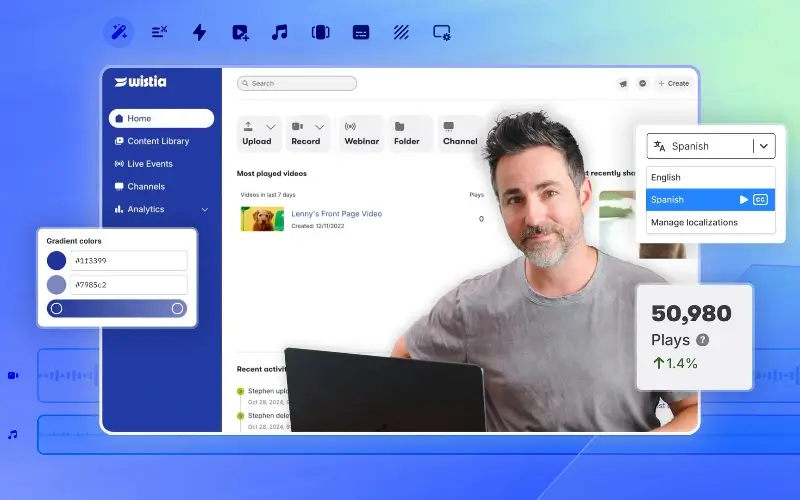
Wistia is better known as a video marketing platform than a dedicated webinar tool, but that is exactly why it earns a place on this list. Its live webinar capabilities are solid, but the bigger advantage is what happens after the event: recordings move straight into Wistia’s video ecosystem, where teams can edit, host, distribute, and continue measuring them as ongoing marketing content.
That makes Wistia especially useful for teams that want to extend the value of a webinar beyond the live session. A single event can become an on-demand recording, shorter clips, social content, or other reusable video assets without moving the footage into a separate platform.
Standout features:
- Built-in video editing and clipping: Turn webinar recordings into shorter videos and social clips inside Wistia instead of moving the footage into a separate editing workflow.
- Automatic recording library: Once a webinar ends, the recording is automatically saved to the selected folder in your Wistia account, where it can be edited, embedded, published, or made available on demand.
- Embedded webinar experience: Embed the full webinar on your own site, including registration, the live event room, chat, Q&A, polls, and the on-demand recording, so attendees can stay on your domain throughout the experience.
- Registration pages and forms: Create branded registration pages, collect custom attendee information, and sync registrations with tools such as HubSpot, Marketo, and Pardot.
Pros:
- Makes it easy to turn one webinar into multiple pieces of reusable video content without adding a separate editing or hosting platform.
- Marketing teams already using Wistia for video can add webinars without introducing another vendor or moving recordings between systems.
- Webinar recordings keep the same hosting, analytics, embedding, and distribution capabilities as other Wistia videos, so their value can continue well beyond the live event.
Cons:
- Wistia’s webinar branding is comparatively controlled: teams can adjust things like logos, colors, fonts, backgrounds, rounded corners, and remove the “Powered by Wistia” badge, but it does not offer the deeper room-layout and production customization.
- Wistia is expensive relative to its included webinar capacity and duration. The standard Webinars plan includes up to 500 attendees and 1.5-hour events, while Webinars Plus supports 1,000 attendees and 3-hour events; going over those limits incurs additional charges.
G2 rating: Wistia has a 4.6/5 rating from more than 1,192 reviews on G2, but this score reflects the Wistia platform overall, not its webinar functionality specifically.
Pricing / free trial: Wistia’s Webinars plan starts at $537 per month and includes up to 500 attendees per event and 1.5 hours of event time. Webinars Plus starts at $1,037 per month and increases those limits to 1,000 attendees and 3 hours. Additional attendees are currently charged at $0.20 each, while additional event time costs $2 per minute. Larger plans use custom pricing, and a 14-day webinar trial is available.
Best for: Content and marketing teams that want to turn webinar recordings into clips, on-demand content, and other reusable video assets after the live event.
How to Choose the Best Webinar Platform

Start with what you need the webinar to achieve, whether that’s generating leads, training employees, running product demos, hosting interactive workshops, or turning webinars into evergreen content. Your goal determines which of the criteria below deserve the most weight.
Don’t choose a platform based on how many features it has. Focus on whether it supports the specific format, level of interaction, integrations, post-event workflow, and capacity your webinars actually require.
Which Webinar Platform Should You Shortlist?
Once you know what matters most, narrow the field based on the outcome you are trying to achieve.
A useful way to narrow your shortlist is to identify your three non-negotiables first and compare platforms against those before worrying about everything else.
If active participation is one of your non-negotiables where attendees don’t just watch but actually interact, Remo is worth a closer look. You can present to the whole audience, run polls and quizzes, bring attendees on stage, and then move into smaller face-to-face table conversations without sending everyone to another tool. Book a demo to see how Remo can help you turn your next webinar into a more interactive experience.
Frequently Asked Questions About Webinar Platforms
1. What is the best webinar platform?
There is no single best webinar platform for every use case. Remo is strong for interactive webinars, Zoom Webinars for large-scale broadcasts, Livestorm or ON24 for lead generation, Demio for easy setup, eWebinar for automated sessions, and Wistia for repurposing recordings. The right choice depends on your audience size, format, engagement needs, integrations, and budget.
2. What features should I look for in webinar software?
Look for a platform that matches how you plan to run, promote, and follow up on your webinars. Reliable video and easy attendee access should be the baseline, but the right feature set also depends on your audience size and business goals.
Key features to compare include registration, engagement tools, recording and replays, analytics, CRM and marketing integrations, and enough capacity for your expected audience.
3. What’s the difference between webinar software and video conferencing software?
Video conferencing software is primarily designed for many-to-many meetings, where small groups of participants can speak and collaborate directly. Webinar software is typically designed for presenting to an audience and adds features such as registration, moderation, analytics, recording, audience engagement, marketing integrations, and automated follow-up.
4. What is the best webinar platform for audience engagement?
The best choice depends on what you mean by engagement. Livestorm and ON24 turn engagement into lead data, eWebinar adds interactive elements to automated sessions, and Remo lets attendees come on stage, answer quizzes, and join small-group table conversations during the webinar. For discussion-heavy sessions like workshops and training, Remo is the strongest fit, with up to 1,000 attendees per virtual space.
5. Can I host a webinar for free?
Yes, some webinar platforms offer free plans or free trials. However, free options usually come with limits on attendee capacity, event length, branding, analytics, automation, or advanced webinar features. They can work well for testing a platform or running small events, but larger or more professional webinar programs typically require a paid plan.
6. Are webinars still effective in 2026?
Yes. Webinars remain useful for lead generation, product demonstrations, customer education, training, and audience engagement. Their effectiveness depends on matching the format to the goal. A sales webinar, training session, automated demo, and interactive event all require different levels of engagement, follow-up, and platform functionality.
Aniqa Iqbal
Aniqa is a content writer at Remo, where she merges her love for storytelling from movies and TV shows with her passion for creating compelling content. With a knack for blending pop culture references and relatable narratives, Aniqa crafts content that informs and resonates deeply with readers. She aims to strike a chord with her audience, fostering genuine connections through words that inspire, engage, and entertain. When she's not writing, Aniqa can be found binge-watching her favorite shows, always on the lookout for the next story to tell.