How to Justify Virtual Career Fair ROI to Your Dean or Provost

Career services teams can usually feel when a virtual career fair hits the mark. The "room" is active, students are engaging, and recruiters are leaning in. But when it’s time to report that success to a dean or provost, a high attendance count is rarely enough to secure next year's event budget.
Senior leadership is playing a much larger game. They aren't just looking at headcounts; they’re evaluating measurable student outcomes, institutional reputation, and virtual event ROI. They want to know if that virtual career fair platform you’re using is a temporary expense or a long-term engine for graduate success.
A high registration count looks great on a slide, but it doesn’t communicate strategic value. To secure long-term funding, you have to stop positioning virtual career fairs as "event expenses" and start presenting them as measurable investments.
This guide explains how to bridge that gap, helping you translate event data into the leadership language your dean or provost needs to see to justify continued investment.
{{table-of-contents}}
What Deans and Provosts Actually Care About
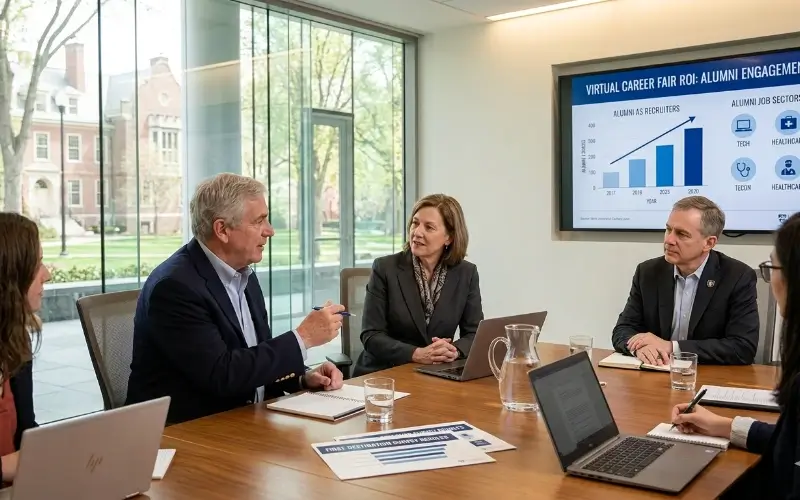
When presenting virtual career fair ROI to senior leadership, attendance numbers alone rarely make the cut. Deans and provosts focus on broader institutional health, which means your reporting needs to bridge the gap between event performance and university priorities.
Student Outcomes
Leadership wants to see how the event supports student success.This goes beyond networking and focuses on tangible results:
- Internships and Interviews: Are students securing internship opportunities and meaningful interview connections?
- Job Placements and Career Readiness: Is the event helping students move closer to employment and stronger career preparedness?
Employer Relationships
The number of participating employers matters, but quality matters more. Leadership evaluates:
- Repeat Attendance: Are top-tier employers coming back every year?
- Strategic Alignment: Do these companies align with your specific academic programs?
Institutional Reputation
A virtual fair is a window into how the university prepares its students. Reputation is shaped by:
- Employer Satisfaction: How recruiters perceive your university as a talent source.
- The Recruiting Brand: High student engagement and professional behavior boost the university's credibility.
Budget Efficiency
Finally, deans and provosts need how much does it cost to hold a virtual career fair. They need to know that resources are being used wisely. ROI is at its strongest when you can prove:
- Financial Savings: Lower venue costs, eliminated travel expenses, and reduced catering.
- Staff Efficiency: Smarter allocation of human resources through automation.
Ultimately, deans and provosts aren't evaluating the event. They’re evaluating its impact on the university’s mission. When your reporting connects virtual career fairs to student outcomes, stronger employer partnerships, and resource efficiency, you stop asking for a budget and start presenting a strategic solution.
Shift the Conversation from Cost to Institutional Value

One of the biggest mistakes career services teams make is presenting a virtual career fair as an expense rather than an investment. When you start with "this event costs $X," leadership views it as a budget line to be cut rather than a strategic initiative to be grown.
To change the narrative, you must shift the focus toward the unique value a virtual format creates for the institution:
- Expanded Student Access: Virtual formats bridge the gap for students who typically get left behind, including remote learners, international students, and those balancing full-time jobs.
- Inclusive, Borderless Participation: By removing travel barriers and physical constraints, virtual career fairs create a more accessible environment for students with disabilities and those from satellite campuses. They also enable greater alumni and mentor involvement, while connecting students with employers beyond their local region, expanding both participation and opportunity.
When you lead with these outcomes, you shift the discussion from "how much can we save?" to "how much value can we create?"
Key Metrics That Help Prove Virtual Career Fair ROI

To move leadership from skepticism to support, you need more than general feedback. You need hard data. The goal isn’t to drown them in spreadsheets, but to highlight specific indicators that connect the event to student success, employer engagement, and institutional efficiency.
Focus on these four core areas to build your case:
1. Student Impact Metrics
These numbers prove that the event actually moves students closer to a paycheck.
- The Data:
- registrations
- attendance rate
- student-employer conversations
- interviews scheduled
- applications submitted
- job offers or placements
- Why it matters: These metrics show whether student participation actually translated into real hiring outcomes. When registrations turn into conversations, interviews, and ultimately offers or placements, it demonstrates that the event created tangible career pathways, not just passive attendance.
2. Employer Engagement Metrics
These reflect the strength and quality of employer relationships.
- The Data:
- total employers attending
- repeat employer participation
- employer satisfaction feedback
- booth visits and engagement levels
- Why it matters: Strong employer retention signals that your students are high-quality candidates worth coming back for.
.webp)
3. Efficiency Metrics
These help justify budget decisions and operational performance by attaching a specific price tag to every outcome.
- The Data:
- Cost per student attendee: Total Event Cost ÷ Number of Students Attended
- Cost per employer: Total Event Cost ÷ Number of Participating Employers
- Cost per interview: Total Event Cost ÷ Number of Interviews Conducted
Cost savings vs in-person events: (In-Person Event Cost – Virtual Event Cost) ÷ In-Person Event Cost × 100
- Why it matters: It shows that you are delivering better outcomes with fewer resources.
4. Access and Equity Metrics
These are your most powerful data points for deans and provosts focused on diversity and inclusion.
- The Data:
- participation from remote students
- international student attendance
- accessibility accommodations and inclusive participation
- Why it matters: It positions the event as a key player in broader institutional goals around equity and inclusive student support.
For a deeper look at which virtual career fair metrics matter most and how to report them effectively, read our complete guide on virtual career fair metrics.
Compare Virtual ROI Against In-Person Career Fairs
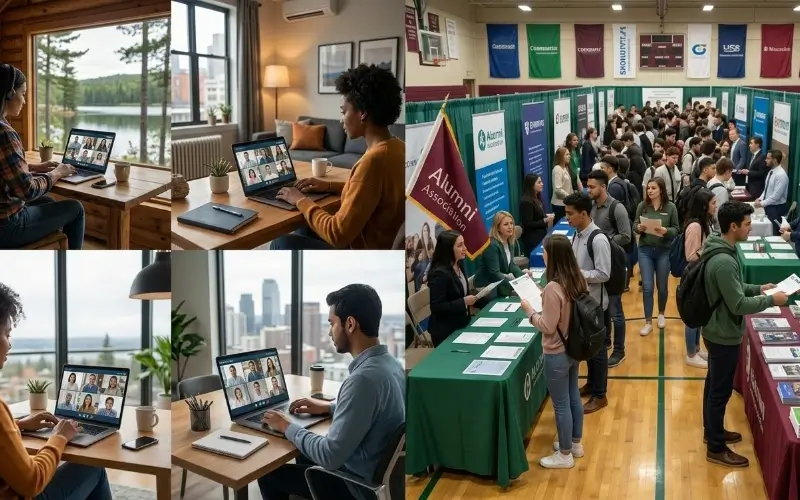
One of the strongest ways to justify a virtual career fair is by comparing it directly to an in-person event. While traditional fairs can drive strong attendance, virtual formats often deliver better ROI through cost efficiency, broader student access, and easier scalability.
Instead of just looking at the number of people in the room, leadership should evaluate the full operational picture:
Where Virtual Career Fair Wins
- Financial Discipline: You instantly eliminate the big ticket expenses, such as venue rentals, catering, printed signage, and travel reimbursements.
- Breaking Barriers: Participation isn't limited by a zip code. Remote students, international learners, and out-of-state employers can all connect without a plane ticket.
- Data-Driven Insights: Unlike a physical room where engagement is hard to track, virtual platforms show you exactly who talked to whom, which booths were popular, and where the follow-up opportunities lie.
The question for leadership isn't just "which is cheaper?" It's "which format creates more long-term value with the least amount of operational strain?"
How to Present the Business Case to Your Dean or Provost
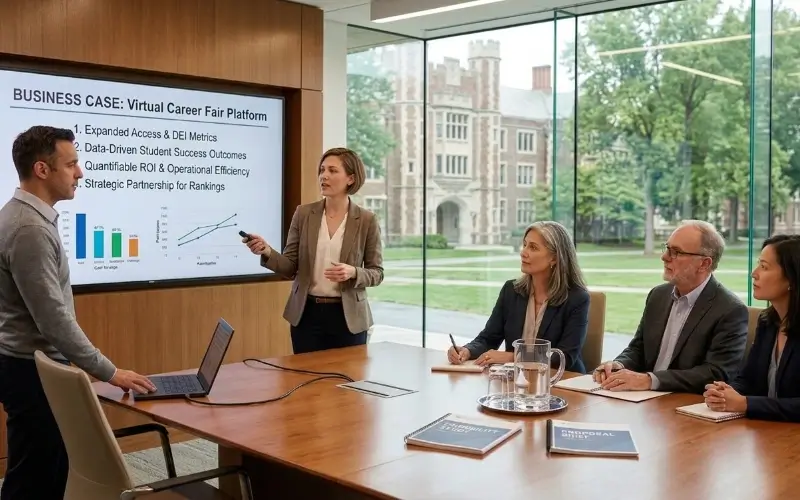
Numbers alone won't secure a budget. A compelling business case connects your career fair data directly to the high-level goals, like student retention and post-grad outcomes, that keep your Dean or Provost up at night.
Follow this four-step sequence to align your request with leadership priorities:
1. Lead with the "Why" (The Institutional Need)
Don't start with a software demo; start with a student's needs. Highlight the gap in employer access for students who face location barriers, scheduling conflicts, or accessibility challenges.
- The Pivot: Frame the discussion around student success to make it immediately relevant to senior leadership.
2. Define the Investment (Not Just the Price)
Be clear about what resources are required, like platform costs, staffing, and marketing, but focus on what those resources unlock.
- The Pivot: Instead of saying "The software costs $X," say "This investment enables us to reach 30% more employers globally."
3. Show the Receipts (Measurable Outcomes)
Bring the "proof points" that make ROI visible: student engagement rates, interviews scheduled, job placements, and participation from underrepresented groups.
- The Pivot: These aren't just stats. They are evidence of a functioning talent pipeline.
4. Connect to the Big Picture (Institutional Value)
End by showing how these results move the needle on university-wide goals like student retention, graduate employability, and even national rankings.
When presenting, use concise, leadership-focused bullet points:
- "This format expands access for students who cannot attend in person."
- "We’ve reduced event overhead while simultaneously increasing our employer reach."
- "The data shows this event directly improved student career outcomes and placements."
- "This initiative supports our broader institutional goals around graduate employability."
How Virtual Career Fair ROI Supports Long-Term Institutional Success
Justifying the ROI of a virtual career fair starts with shifting the narrative: you aren't just reporting on an event; you are reporting on institutional health. Your dean or provost wants to know how the fair moved the needle on student success, employer loyalty, and campus-wide accessibility.
When you lead with clear virtual event metrics and tie them directly to the university’s long-term strategy, budget conversations stop being a pitch and start being a shared goal. Virtual fairs then cease to be a budget line item and become a cornerstone of your institution’s career readiness brand.
Ready to make the case even stronger? Platforms like Remo help career services teams prove their value by delivering the engagement data and high-touch networking experiences that senior leadership expects. If you're planning your next fair, book a demo and see how Remo can help you build an event that is easier to justify, easier to scale, and impossible to ignore.
FAQs about Virtual Career Fair ROI
1. How do you measure virtual career fair ROI?
Virtual career fair ROI is measured by comparing event costs with outcomes like interviews, internships, job placements, and employer engagement. Metrics such as cost per hire, repeat employer attendance, and conversion rates help show real value.
2. Are virtual career fairs more cost-effective than in-person career fairs?
In many cases, yes. Virtual fairs reduce costs like venue rentals, travel, and catering while expanding access for students and employers across different locations.
3. Why do deans and provosts care about virtual career fair ROI?
They want to know if the investment improves student success, employer partnerships, and graduate employability. ROI helps them decide whether the event supports broader university goals.
Aniqa Iqbal
Aniqa is a content writer at Remo, where she merges her love for storytelling from movies and TV shows with her passion for creating compelling content. With a knack for blending pop culture references and relatable narratives, Aniqa crafts content that informs and resonates deeply with readers. She aims to strike a chord with her audience, fostering genuine connections through words that inspire, engage, and entertain. When she's not writing, Aniqa can be found binge-watching her favorite shows, always on the lookout for the next story to tell.