The Ultimate Guide to Virtual Education Fairs for Universities and Colleges

Education fairs are meant to open doors, but for many students and institutions, they’ve long done the opposite. Crowded venues, rushed conversations, limited reach, and high costs leave students overwhelmed and universities struggling to connect meaningfully. Too often, the most important questions go unanswered simply because time, distance, or logistics get in the way.
As expectations change and global recruitment becomes more complex, the traditional fair model is starting to show its limits. Students want flexibility and clarity. Institutions need reach, insight, and efficiency. The entire experience needs to be rethought to deliver real value for both sides.
This is where virtual education fairs enter the picture. Built on the foundation of a modern virtual event platform, they replace one-off interactions with ongoing exploration, and physical constraints with intentional design. In this guide, we take a closer look at how these fairs work, why they’re growing, and what it takes to create experiences that are useful, immersive, and worth showing up for.
{{table-of-contents}}
What Is a Virtual Education Fair?
.webp)
For years, organizers watched students move through crowded halls, collecting brochures they’d rarely revisit and rushing between conversations with little time for depth. Access was limited to who happened to be present, and once the event ended, so did the interaction. For organizers, this meant high effort, high cost, and surprisingly little lasting impact.
Virtual education fairs succeed where traditional fairs fall short. A virtual education fair is an online event where multiple universities and institutions come together in a shared digital space to connect with students. Within this structured environment, students can explore programs, attend live sessions, and have one-on-one conversations without the constraints of location or time zones. Instead of relying on physical booths and brief encounters, institutions host interactive spaces, presentations, and discussions that students can access from anywhere.
Rather than compressing discovery into a rushed afternoon, virtual education fairs give students time and space to explore. In a digital environment built for clarity over urgency, students can move between programs, join live conversations, ask questions on their own terms, and return to information whenever they need.
That shift, from speed to depth, is what changes everything.
Why Virtual Education Fairs Are Growing

The growth of virtual education fairs isn’t accidental. It’s the result of shifting student expectations, rising recruitment costs, and a world that now expects access to be instant, flexible and on-demand.
A. From Pandemic Catalyst to Permanent Adoption
When in-person recruitment came to a sudden halt, institutions and students adapted quickly by shifting online. Virtual education fairs became the only way for universities to stay visible and connected with prospective students. But when the pandemic finished, something unexpected happened. Institutions continued to host online, and students continued to attend.
By then, virtual fairs had proven they could deliver reach, event engagement, and real outcomes without the cost, logistics, and friction of physical events. What started as a temporary solution evolved into a long-term recruitment strategy.
B. Understanding Gen Z Student Behavior
At the center of this shift is a new generation of prospective students. Gen Z prefers to research independently and online first, which means their education journey naturally starts in digital environments rather than physical fairs.They start on their phones, explore options quietly, compare institutions on their own terms, and form opinions early, often long before they ever speak to a university.
They are globally curious, open to studying beyond traditional destinations, and drawn to real conversations instead of polished messaging. Virtual education fairs fit naturally into this mindset, giving students room to explore at their own pace, while still offering direct, authentic interaction when they are ready for it.
C. Intensifying Competition Between Institutions
Competition for students continues to increase, and visibility alone is no longer enough. Institutions are expected to reach more regions, respond faster, and stay present throughout the decision cycle.
Virtual education fairs make this possible to achieve without adding cost or headcount. Schools can test new markets, engage students more often, and expand their reach with far less friction.
Virtual education fairs reflect how students prefer to explore options and how institutions must now operate. As that alignment grows, virtual education fairs will continue to move from alternative to default, reshaping how global education recruitment works.
Benefits of Virtual Education Fairs

For today’s digitally native students, virtual education fairs feel natural, accessible, and low-pressure. At the same time, institutions gain scalable reach, measurable engagement, and more useful conversations.
Why Universities, Schools, and Recruiters Should Host Virtual Education Fairs
As student discovery evolves, recruitment strategies must evolve with it. Virtual education fairs offer institutions a structured way to engage prospective students at scale, supporting visibility, efficiency, and informed follow-up across recruitment efforts.
Here are six key ways virtual education fairs support schools, universities, and recruiters:
1. Massive Recruitment Reach: Institutions can engage students across multiple regions simultaneously without physical travel. Recruitment becomes borderless, scalable, and far more inclusive.
2. Lower Recruitment Costs: Virtual education fairs dramatically reduce the hidden and visible event costs. They eliminate travel, printing, and physical booth expenses. Schools can scale from hundreds to thousands of students with minimal added cost.
3. High-Quality Data & Insights: When hosted online, every interaction is trackable, from booth visits to session engagement. This data enables smarter follow-ups, personalized outreach, and continuous optimization of recruitment efforts.
4. Stronger Engagement Tools: Live Q&As, small-group discussions, alumni sessions, and virtual tours are easier to run and easier to join online. Without physical space limits or time pressure, conversations become more interactive and student-led, shifting recruitment from one-way presentations to genuine engagement.
5. Better Brand Visibility & Control: At virtual education fairs, institutions control how their story is told through videos, visuals, and content that remains accessible even after the event is finished. This way, brand impact extends well beyond the live fair.
6. Environmental & Social Impact: Virtual fairs reduce carbon emissions and material waste while expanding access to underserved regions. Online recruitment aligns with sustainability and inclusion values expected by modern students.
Why Students Should Attend Virtual Education Fairs
A student’s journey to higher education these days often starts with a click. Virtual education fairs have reshaped how students explore their futures, opening doors that were once closed by distance, cost, or circumstance.
Below are the five core benefits that make virtual education fairs such a powerful tool for students everywhere:
1. Access & Inclusivity: Virtual education fairs remove geographic, financial, and visa barriers. Students can explore institutions worldwide from any device, making global education accessible regardless of location or background.
2. Information Depth & Transparency: Students get direct access to admissions teams, faculty, alumni, and financial aid advisors, alongside rich digital resources. This creates a clearer, more realistic understanding of programs and campus life.
3. Cost & Time Savings: With an online education fair, students can explore dozens of universities without travel, accommodation, or time away from school. Research that once took weeks can now happen efficiently within their own schedule.
4. Personalized Exploration: In a virtual education fair, AI-powered recommendations, targeted sessions, and one-on-one meetings are easier to deliver because the experience is built around digital data and behavior. Instead of navigating dozens of booths, students are guided toward relevant programs and conversations, allowing the fair to adapt to their interests rather than overwhelm them with options.
5. Empowerment & Global Perspective: Hosting a virtual education fairs gives students exposure to new countries, cultures, and academic pathways. This broadens students’ ambition and confidence, letting them see themselves as global learners with informed choices ahead of them.
Types of Virtual Education Fairs

Every virtual education fair has its own character. Some are built for early-stage exploration, others for deeper academic discovery, and some for students who are close to making a final decision. Understanding these differences helps institutions choose the right virtual event type and helps students know what kind of experience to expect when they log in.
Some common types of virtual education fairs are:
- General Higher Education Fairs: Wide-ranging events that bring together institutions across disciplines, countries, and degree levels. These are perfect for students who are just beginning to explore their options.
- Study Abroad Fairs: Focused on universities recruiting international students. These fairs feature information on visas, cultural life, housing, language requirements, and global scholarships.
- Subject-Specific Fairs: Built around a particular field such as STEM, Medicine, Arts, Business, Engineering, or IT. Students get a deeper look into programs, labs, faculty, and career pathways specific to a field.
- Scholarship & Financial Aid Fairs: Events dedicated entirely to funding opportunities. Students meet sponsors, scholarship committees, and financial aid teams who guide them through costs and eligibility.
- Application & Admissions Support Fair: Designed for students approaching deadlines. Sessions include document prep, essay reviews, interviews, portfolio workshops, and Q&A with admissions advisors.
While the type defines what the virtual education fair focuses on, the format defines how students experience it. Some virtual education fairs run fully live, with real-time sessions, chats, and meetings that create urgency and energy. Others stretch across multiple days, often using themed tracks to make large events easier to navigate. Hybrid formats also exist, combining physical events with virtual booths and online sessions to extend reach beyond a single location.
Regardless of format, the strongest virtual education fairs are designed to reduce friction, guide students toward what’s relevant, and make meaningful conversations easy to start.
Core Features of a Modern Virtual Education Fair Platform

A modern virtual education fair platform does more than host an event. It quietly shapes how students explore, how institutions engage, and how organizers keep everything running smoothly behind the scenes.
From the moment a student logs in to the point where an institution follows up after the event, the platform acts as the connective layer holding everything together. These are the features that make that experience possible.
A. Event Lobby
The event lobby is the digital front door of a virtual education fair. It is considered the first impression, and the place where orientation begins. A well-designed lobby immediately sets the tone for the entire event.
A strong lobby includes:
- Welcome video introducing the event and guiding students on what to do next
- Clear event navigation so attendees can explore halls, virtual booths, and sessions without confusion
- Live announcements highlighting sessions starting soon, special offers, or important updates
- Region-based halls grouping universities by country or category
- Recommendation widgets that guide students toward booths and sessions that align with their interests
B. Virtual Booths
Virtual booths are where most of the student-university interaction happens. They’re the online version of stopping at a stand, asking questions, and getting a feel for an institution. A modern booth should be immersive, intuitive, and rich with actionable information.
Effective booths offer:
- Branding options that let institutions showcase their identity
- Videos, 360/immersive demos, and presentations to bring programs and campuses to life
- Live chat & high-quality audio video call features for real-time conversations
- Lead forms that capture student interest and intent
- Instant downloads for quick access to guides and brochures
- Clear call-to-action buttons such as Apply Now, Book Meeting, or Learn More
C. Live Sessions
Live sessions bring energy to the event. They turn the fair from something students passively scroll through into something they actively participate in, with real conversations, real voices, and meaningful interaction.
Strong virtual event platforms support:
- Webinars and Q&A panels for real-time engagement
- Faculty-led discussions that dive into programs and academic pathways
- Student ambassador sessions sharing honest, relatable perspectives
- Scholarship and visa workshops explaining processes clearly
- Country-specific sessions offering cultural insight and destination guidance
- Interactive demonstrations of labs, studios, equipment, and facilities
.webp)
D. Communication Channels
What really makes a virtual fair work is how easy it is for people to connect and talk. The best online platforms make conversations feel natural, comfortable, and easy.
Essential communication tools include:
- Group chat for open discussions
- Private chat for personal questions
- Video rooms for face-to-face interaction
- Scheduled appointments for structured, high-value conversations
- AI chatbots to answer quick questions and guide students
E. Engagement Features
Engagement is the key to keeping students active, curious, and motivated. The right platform turns passive browsing into dynamic participation.
High-engagement platforms include:
- Polls to keep sessions lively
- Surveys to capture insights and feedback
- Gamification elements that reward exploration
- Digital scavenger hunts that encourage booth visits
- Leaderboards that add excitement and momentum
F. Integrations
No modern event is complete without seamless integrations. Integrations connect the fair to existing systems, making follow-up easier, faster, and more accurate. This way the event continues to deliver value even after it ends.
Key integrations include:
- Higher-education CRMs such as Slate, Salesforce Education Cloud, HubSpot, or region-specific student recruitment CRMs
- Email automation for instant follow-ups
- SMS reminders to reduce no-shows and boost attendance
- Calendar integration for booking meetings
- University Application system connecting students directly to the next step
G. Accessibility Features
Accessibility is not optional. A modern platform must work for every student, regardless of bandwidth, device, language, or ability, so no one is excluded from the experience.
Must-have accessibility features:
- Closed captions for all live and recorded sessions
- Screen reader support for visually impaired students
- Multi-language capabilities for diverse audiences
- Time zone conversion across all sessions and schedules
- Low-bandwidth modes for regions with limited internet access
A modern virtual education fair platform is ultimately about connection. When these features come together, the experience feels simple, inclusive, and purposeful.
Best Virtual Education Fair Platforms
While many virtual education fair platforms promise similar outcomes, the experience they create can differ significantly in terms of access, interaction, scale, and complexity. Below, we look at three leading platforms, each taking a distinct approach to how students and institutions explore, connect, and engage.
1. Remo
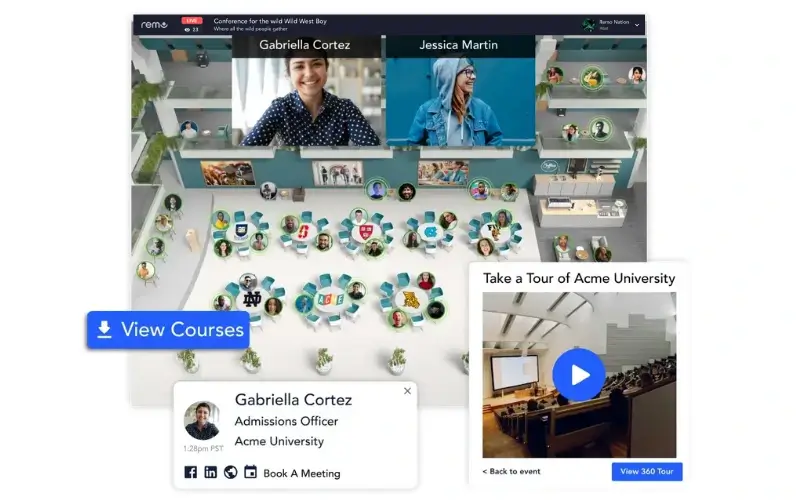
Remo is a virtual event platform built around one core idea: humanizing online events. Instead of guiding students through menus or static booths, Remo gives them a shared virtual space where they can move freely, join conversations, and engage, much like they would at a physical campus fair.
The platform is designed for institutions that care about genuine conversations, connection quality, and ease of participation.
Key Features
- Immersive Floor Plans: Remo uses map-based floor plans that let students move naturally between tables, just like walking through a physical fair. This layout encourages exploration and makes it easy to see participating universities and where conversations are happening in real time.
- Interactive Virtual Booths: Every booth functions as a live video space for small-group or one-on-one discussions. Students can also join, leave, and move between booths freely, keeping interactions flexible and informal.
- Presentation Mode: Remo includes a virtual stage for keynotes, panels, and information sessions. Once a session ends, attendees can smoothly return to networking without leaving the event space.
- Seamless Integrations & Workflow Connectivity: The platform integrates with CRMs, email tools, calendars, and analytics platforms, making it easy to capture leads, sync data, and automate follow-ups so conversations continue after the fair ends.
- Built-In Accessibility: Remo includes native accessibility features such as closed captions for live sessions, making events more inclusive for students with hearing impairments and those joining in noisy or multilingual environments.
Pricing
Remo’s pricing is flexible. Every plan includes the full feature set, you simply choose the option that best fits how often and at what scale you want to run events.
- Subscription Plan (from $299/month): Best for teams running multiple events or ongoing spaces throughout the year. Supports up to 1,000 attendees with unlimited events or spaces.
- One-Time Event Plan (from $699/event): Ideal for single, large-scale education fairs without a long-term commitment.
- Enterprise Plan (custom pricing): Designed for large organizations with advanced needs, always-on spaces, or dedicated support.
Free Trial: 14-day free trial available, no credit card required.
2. vFairs
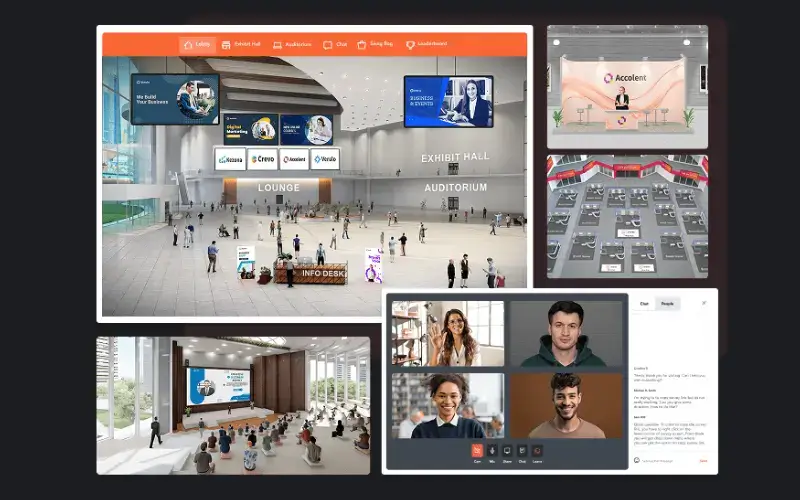
vFairs is a well-established virtual events platform commonly used for large-scale fairs. It focuses on recreating the structure of a traditional fair online, complete with 3D lobbies, exhibit halls, and content-heavy booths.
Unlike Remo, where booths act like live breakout rooms and students can instantly speak face-to-face with representatives, vFairs is primarily booth- and content-driven. In vFairs, students typically browse resources or use chat first, and live video conversations require requesting and setting up a separate call. This makes the experience more navigational and passive, rather than centered on spontaneous, live audio/video conversations.
Key Features
- 3D Virtual Exhibit Halls: vFairs offers fully branded virtual booths where institutions can showcase programs through videos, brochures, and downloadable resources.
- Live Chat & Scheduling: Similar to Remo, this platform supports one-on-one and group live chats. It also offers meeting queues to manage high traffic.
- Webinars & Auditoriums: vFairs includes virtual auditoriums for live and on-demand presentations like info sessions, panels, and talks.
- Advanced Analytics: Organizers and institutions receive detailed reports on booth visits, session attendance, content downloads, and engagement patterns.
Pricing
- vFairs uses a custom pricing model based on event size and complexity, with annual licenses (Basic, Premium, Enterprise) as well as single-event options.
- Plans vary by registration limits, support level, and access to integrations, with higher tiers designed for large, multi-event programs.
- There is no free plan or trial, and pricing details are provided only on request.
3. MootUp
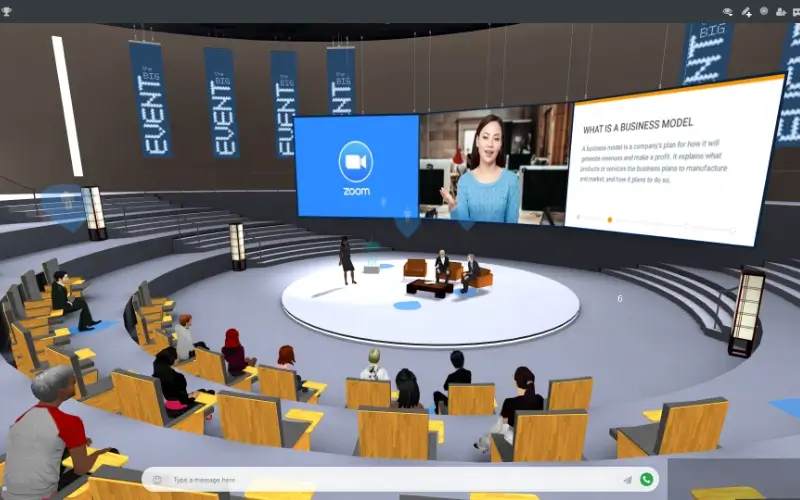
MootUp is a metaverse-style virtual events platform that uses 3D, avatar-based environments to simulate in-person education fairs. While MootUp delivers a highly immersive experience, it can introduce more technical complexity.
However, organizers who want quicker conversations and easier access may find Remo more practical, especially for students joining from different devices and internet conditions.
Key Features
- 3D Virtual Venues: MootUp offers fully immersive 3D spaces such as campus halls, auditoriums, and expo floors where attendees navigate as avatars. These environments are designed to simulate real-world movement and spatial awareness during a fair.
- Virtual Booths: Institutions can create branded 3D booths featuring videos, brochures, and interactive content. Students enter booths as avatars and can explore materials or speak live with representatives using in-booth audio or chat zones.
- Live Interaction Tools: The platform supports text chat, voice chat, video conversations, live Q&A, polls, and breakout rooms.
- AI-Powered Assistance: MootUp offers AI chatbots that can answer common student questions and provide guidance when staff members are unavailable, helping booths stay responsive beyond live hours.
Pricing
- MootUp does not publish fixed pricing publicly and operates on a custom quote model based on event size, duration, and feature requirements.
- Costs typically scale with attendee volume, use of 3D environments, and level of customization.
- Trials are usually offered only through direct sales conversations.
How to Plan a Virtual Education Fair

A successful virtual education fair doesn’t come together by chance. It’s the result of thoughtful event planning, clear structure, and steady coordination across teams. Whether you’re hosting a small institutional open house or a global, multi-country fair, the process follows the same rhythm: plan early, build carefully, promote clearly, and execute smoothly.
Below is a practical, phase-by-phase roadmap to help organizers run a fair that feels smooth, engaging, and high-impact from start to finish.
Phase 1: Foundations (8–12 weeks out)
This phase determines whether your virtual education fair will feel focused or fragmented. Most of the problems that come up later in the process trace back to vague decisions that are made here.
Start by clarifying why the fair exists. Is the goal to help students explore options, narrow choices, understand application pathways, or move closer to applying? Each objective demands a different structure, tone, and pace.
Once the primary goal is clear, define success in measurable terms. Avoid tracking everything. Instead, focus on a small set of indicators that reflect significant value, such as:
- Quality of student registrations (not just volume)
- Number of meaningful conversations per student
- Session completion or drop-off rates
- Follow-up actions like meeting bookings or applications
Next, define the audience with equal precision. A virtual fair designed for early-stage high school students should feel very different from one aimed at postgraduate or international applicants. Consider:
- Academic stage and decision readiness
- Geographic spread and time zones
- Device usage and bandwidth constraints
- Language and accessibility needs
With your goals and audience clearly defined, decide on your content formats. This step should come before inviting institutions. Panels, live Q&As, workshops, networking spaces, and one-on-one meetings each require different preparation, staffing, and expectations. Defining formats early ensures institutions know exactly how they’ll participate and what’s expected of them.
At this point, begin confirming participating institutions. Early confirmation allows schools and universities to commit resources, prepare content, and align their teams with the fair’s structure and goals. Clear expectations at this stage lead to better booths, stronger sessions, and fewer last-minute issues later on.
Only after these decisions are made should you look at the best virtual event platforms and select one. The key question isn’t what the platform can do, but how well it supports:
Only after these decisions are made should you look at the best virtual event platforms and select one. The key question isn’t what the platform can do, but how well it supports:
- Fast, natural conversations
- Easy navigation without explanation
- Engagement that continues beyond the live event
Finally, build a realistic timeline and virtual event budget. This should account for platform costs, promotion, design, staffing, onboarding, accessibility, and post-event reporting. Early clarity here prevents rushed compromises later and sets the foundation for a fair that feels intentional rather than improvised.
Phase 2: Build (6–8 weeks out)
This is the phase where planning becomes tangible. The structure is set, the institutions are confirmed, and the virtual fair starts to materialize. But, be careful, because this is also where many virtual education fairs fall apart by trying to do too much. The goal in this phase is not to add features, but to design an experience that feels easy to enter, easy to understand, and easy to engage with.
Design Booths for Fast Clarity
Start with the virtual booths. Students don’t approach virtual booths the way they do physical ones. They won’t browse for long or explore deeply on their own.In a virtual fair, the booth’s “front view” or university name is often the only decision point. Well-known institutions benefit from instant brand recognition, while lesser-known universities rely heavily on booth design and messaging to earn attention. If neither the name nor the visual presence resonates immediately, students move on.
For example, in platforms like Remo, a student initially sees the table layout, which university/college is present, how many other prospective students are interacting, and any surrounding context. That brief visual moment determines whether they click in and start a conversation. Unlike in-person fairs, there’s no buffer of foot traffic or chance to be pulled in by overheard conversations; interest must be captured upfront.
Each booth should therefore answer three questions immediately:
- Who is this institution for?
- Why is it relevant to me?
- Who can I talk to right now?
Also remember, content should support conversation, not replace it. A small number of clear, purposeful resources consistently performs better than large libraries of documents.
Finalize Sessions and Agenda Flow
Next, design live sessions to complement your education fair. These sessions are where context, reassurance, and trust are built. Every session should address a real student uncertainty or decision point, not just share information. Sessions that perform best tend to focus on:
- What studying this program actually leads to
- How costs, scholarships, and visas work in practice
- Honest student and alumni experiences
- What life looks like in a specific university
Avoid generic panels. Shorter, focused sessions with strong moderation almost always outperform long presentations.
With session goals confirmed, finalize the event agenda with care. A strong agenda is shaped by:
- Clear purpose for each session (exploration, comparison, application support, or decision-making)
- Time zone considerations and regional accessibility
- Thoughtful session length and pacing to prevent fatigue
- A balanced mix of live sessions and interactive discussions
When done well, the agenda feels intentional and easy to follow, guiding students naturally through the experience instead of overwhelming them.
Plan for Accessibility
Accessibility should be planned alongside all of this, not treated as a final adjustment. These elements should be built in from the start:
- Closed captions for live and recorded sessions
- Screen-reader compatibility across booths and navigation
- Multilingual content or session support where needed
- Low-bandwidth access options for students with limited connectivity
When accessibility is designed early, it improves the experience for everyone, not just those who require accommodations.
Phase 3: Promotion (3–6 Weeks Out)
Event promotion isn’t just about getting the word out. It’s about helping the right students understand why the fair matters to them and what they’ll gain by attending. Strong promotion sets expectations early, so students arrive informed, prepared, and motivated to engage.
Build Email Campaigns
Start with email. This is still the most reliable channel for education fairs, but only when it’s structured well.
- Begin with a clear event invitation that explains who the fair is for and what problems it helps solve.
- Then layer in follow-ups that highlight specific sessions, institutions, speakers, or outcomes students care about.
- Use reminders and countdowns to guide attention, not create noise
Optimize the Landing Page
At the same time, refine your registration page. This is where curiosity turns into commitment. The page should immediately answer three questions: Who is this for? What will I learn? How do I join? Keep the agenda scannable, the value clear, and registration frictionless. If students have to work to understand the benefits, they won’t register.
Run Social Media Campaigns
Social media plays a different role. It’s less about detail and more about momentum.
- Use short videos, session teasers, and behind-the-scenes clips
- Lean on student ambassadors for authentic messaging
- Focus on platforms students already use – Instagram, TikTok, YouTube, WhatsApp, and Facebook, and keep the message human and direct.
Use Media & Community Outreach
Media and community outreach help build credibility and expand reach, especially for international or scholarship-focused fairs. The goal is twofold: borrow trust from established channels and show up where students already gather.
- Share the event with education blogs, study-abroad sites, and trusted media platforms
- Partner with regional student communities, counselor networks, and scholarship portals
- Reinforce credibility by highlighting participating institutions, speakers, and partners
Activate Partner Schools and Counselors
Partner schools and counselors are critical amplifiers. Give them ready-to-use toolkits, such as email copy, posters, social captions, and session highlights, so sharing the event feels easy, not like extra work. When counselors understand the value of the fair, they become advocates rather than just messengers.
Leverage Ambassadors and Alumni
Finally, activate ambassadors and alumni. Personal invitations carry more weight than institutional messaging. When students hear about the fair from someone who’s been through the journey, interest becomes intent.
Phase 4: Pre-Event Prep (1–2 Weeks Out)
This is the phase where confidence is built, or quietly lost. By now, the structure exists and the content is in place. What remains is making sure the entire experience holds together under real conditions. When students arrive, nothing should feel uncertain. When institutions log in, nothing should feel unfamiliar. And when something goes wrong, because something always does, the response should feel calm and immediate.
Test Everything
Small points of confusion compound quickly so start by testing the virtual education fair as if you were a student encountering it for the first time. Not from an organizer’s dashboard, but from the outside. Include participating institutions in this testing as well so they feel confident with the platform, tech requirements, and student flow before the event goes live.
Walk through the full journey:
- Registration and login
- Entry into the lobby or main space
- Navigation between booths and sessions
- Joining chats, meetings, or live sessions
- Accessing recordings or downloads
Finalize Support Plans
At the same time, finalize your support structure. Behind the scenes, your team should know exactly how to escalate technical, access, or session-related problems without hesitation.
Every participant should know:
- Where to go if something doesn’t work
- How quickly they can expect help
- Who is responsible for resolving issues
Share Participating Universities and Key Resources with Registered Students
As the event approaches, communication becomes just as important as the technology itself. This stage isn’t about promotion but also about helping students feel prepared and confident before they arrive. Sharing who’s attending and what’s available allows students to plan their time intentionally instead of logging in unsure of where to start.
Effective pre-event communication should:
- Highlight participating universities and featured institutions
- Share starter resources like program overviews or session highlights
- Suggest where to begin based on student interests
- Encourage students to prepare questions or shortlist booths they want to visit
Equip Counselors and Schools
Finally, equip counselors and partner schools with everything they need to support students on the day. Often, they are the last human touchpoint before the fair begins.
Phase 5: Event Day Operations
Event day isn’t about managing the platform. It’s about protecting the experience. When operations run smoothly, participants don’t notice the work happening behind the scenes, and that’s exactly the point.
The priority on the day is responsiveness. Questions will come in, plans will need adjusting, and unexpected issues will appear. What matters is how quickly and confidently the team responds.
Open Support Early
Start by opening support early. Students and institutions often log in ahead of time to orient themselves, and early questions are common.
Support should be:
- Visible and easy to find
- Staffed by people who know both the platform and the event flow
- Able to resolve or escalate issues quickly
Monitor Activity
Once the fair is live, actively monitor activity across the platform. Don’t wait for problems to surface on their own.
Pay attention to:
- Booths with high traffic or low engagement
- Chats where questions go unanswered
- Sessions where attendance drops suddenly
For example, if a popular booth becomes overcrowded, you may need to guide students toward alternative sessions or open additional conversation spaces. If a session sees drop-offs, a quick notification or moderator prompt can re-engage attendees.
Prepare for Issues
Prepare for issues before they happen so small disruptions don’t derail the trust of students.
Have clear contingency plans for:
- Switching speakers or moderators
- Redirecting attendees if a session is delayed
- Communicating changes quickly and calmly
Moderate Sessions Carefully
Strong moderation is another anchor on event day. A well-moderated session often feels more valuable than a longer, loosely managed one.
Effective moderation ensures:
- Clear session openings and expectations
- Balanced participation in Q&A
- Respectful, welcoming interaction
- Sessions end on time and transition smoothly
Push Notifications
Finally, use push notifications with intention. Notifications should guide, not overwhelm.
Well-timed messages can:
- Remind students when key sessions are starting
- Highlight popular or high-value booths
- Direct attention to scholarships, workshops, or one-on-one meetings
For example, a simple “Starting in 10 minutes: Scholarships for International Students” notification can dramatically increase attendance without adding pressure.
Phase 6: Post-Event (Within 1–7 Days)
When the online education fair ends, the most important work begins. What happens in the days immediately after the event determines whether the fair becomes a pipeline or a missed opportunity.
Review and Prioritize Prospective Students
After the fair, review and organize prospective students while interest is still fresh. Students who showed strong engagement should receive timely, relevant follow-ups, while others can be supported through longer-term guidance and information sharing.
Segment prospective students based on:
- Engagement signals (institutions visited, sessions attended, time spent in conversations)
- Actions taken (questions asked, meetings requested, resources saved or downloaded)
- Expressed interest (programs explored, follow-up requests, application intent)
Gather Feedback from Students and Institutions
Collect feedback from both students and participating institutions to understand what worked, what felt unclear, and where the experience can improve. This qualitative insight complements analytics and helps refine future fairs.
Feedback is most valuable when it’s captured while the experience is still fresh. Virtual education fairs don’t have a single shared end moment, students arrive and leave at different times, so waiting days to ask for feedback often means losing nuance.
How to collect feedback
- Use short, focused surveys rather than long questionnaires
- Embed the survey directly into the post-event flow (for example, showing it immediately after someone leaves the event)
- Keep completion time under 2–3 minutes to increase response rates
When to collect feedback
- Immediately after a participant leaves the event, while their experience is still top of mind
- Follow up with a secondary survey 24–48 hours later for more reflective feedback, if needed
Platforms like Remo make this easier by offering a post-event link that directs participants to a survey the moment they leave the event, capturing feedback while the experience is still fresh, even when attendees join or exit at different times. This is especially useful for virtual fairs that run for hours and don’t have a single fixed start or end time.
What to ask students
- What made them decide to engage (or not engage) with certain booths
- Whether it was easy to understand what each institution offered
- Where they felt unsure, confused, or overwhelmed
- What helped them take the next step (or what blocked them)
- How confident they felt about their next action after the fair
What to ask institutions
- Quality of student conversations, not just volume
- Whether the right students found their booth
- How clear the student journey felt from first interaction to follow-up
- Gaps in information, tooling, or engagement
- Whether the fair met their recruitment or outreach goals
If you’re unsure where to start, these 10 questions for your post virtual event survey offer a solid foundation and can be adapted for both students and institutions.
In most cases, separate surveys for students and institutions work better, since their goals and experiences are very different. This also leads to clearer, more actionable insights.
Review Analytics
Next, review the event metrics, because these insights reveal what actually resonated with students and where friction still exists. Look beyond surface numbers and focus on patterns.
Pay attention to:
- Which booths held attention the longest
- Which sessions were completed versus abandoned
- What questions students asked repeatedly
- Where drop-offs occurred in the experience
Launch Follow-Up Campaigns
With that context, launch thoughtful follow-up campaigns. Generic thank-you emails rarely move students forward.
Strong follow-up often includes:
- Personalized messages referencing sessions or programs viewed
- Clear next steps (book a meeting, apply, download a guide)
- Relevant scholarship, visa, or deadline information
- Options to continue the conversation one-on-one
Share Post-Event Reports
Post-event reporting is equally important. Share clear, actionable summaries with internal teams and participating institutions.
Useful reports highlight:
- Engagement quality, not just attendance
- Top-performing sessions and booths
- Regional or program-level interest trends
- Recommendations for future improvements
Hold an Internal Review
Finally, hold an internal review while the experience is still fresh, to learn from the event outcomes. Talk through what felt smooth for students, where confusion or hesitation appeared, which assumptions held true and which didn’t, and what should change before the next fair. These reflections ensure that each event builds on the last, rather than starting from scratch.
Planning a virtual education fair is both an art and a system. When each phase is handled with intention, the result is an event that feels smooth for students, impactful for institutions, and successful for organizers.
Challenges and How to Overcome Them

Even the best-planned virtual education fairs come with challenges. The good news is that most issues are predictable and fixable. With the right planning and platform choices, common obstacles can be managed before they affect the experience.
Here are some of the most frequent challenges organizers face, and how to address them effectively.
A. Low Attendance
Low attendance often comes down to visibility. Students can’t join an event they don’t know about or don’t fully understand. The solution is stronger, earlier promotion. Clear messaging, targeted outreach, counselor or student ambassador involvement, and well-timed reminder sequences significantly raise attendance. When promotion starts early and repeats consistently, registration numbers improve dramatically.
B. Technical Issues
Technology glitches are one of the biggest fears in virtual events, but most can be avoided with proper preparation. Running full platform tests, rehearsing every session, and having backup streaming options ensure stability. It also helps to provide alternative channels, such as phone support, WhatsApp lines, or email, for students or universities experiencing technical difficulties during the event.
C. Low Engagement
Sometimes students join an event but don’t interact. To prevent this, engagement must be intentionally designed into the experience. Gamification tools, scavenger hunts, quizzes, and interactive polls keep students active. Student ambassadors and moderators can also encourage conversations, highlight popular sessions, and guide attendees to booths that match their interests.
D. Too Many Booths and Student Overwhelm
Large fairs with dozens or even hundreds of booths can overwhelm students. The best way to simplify the experience is through interest-based recommendations. Smart matching tools, themed halls, and “recommended for you” widgets help students focus on options that fit their academic goals, rather than scrolling endlessly through the entire event. Offering curated, structured pathways, such as “STEM Track,” “Study Abroad Track,” or “Scholarship Track”, guides students toward the experiences most relevant to them.
E. Institutional Hesitation
Some universities are still unsure how successful a virtual education fair can really be. Without the usual in-person signals, it’s harder for them to judge impact. Clear data helps them get clarity. When institutions can see concrete results, such as booth visits, session attendance, meeting requests, or follow-up actions, it becomes easier to understand the value of participating. Sharing past results and performance metrics builds confidence, shows what “success” looks like, and helps universities improve their approach for future fairs.
Challenges are inevitable, but they don’t have to disrupt the experience. When organizers anticipate them and respond intentionally, virtual education fairs become smoother, more engaging, and more effective for everyone involved.
The Future of Virtual Education Fairs
.webp)
The next chapter of virtual education fairs is not about being “more digital.” It is about being more intelligent, responsive, and experience-led. As student expectations evolve and recruitment becomes increasingly global, virtual fairs are transforming from one-time events into living ecosystems that support discovery, decision-making, and trust over time.
What follows are not distant ideas. They are signals of where the experience is already heading.
A. AI Event Assistants
Virtual fairs will increasingly feel guided, not navigated. AI event assistants will act as real-time companions, answering questions, suggesting next steps, reminding students about sessions, and helping them find what they need without friction.
B. Predictive Analytics for Recruitment
Data will move from reporting the past to shaping the future. Recruitment teams will use predictive insights to understand which students are most likely to apply, enroll, or need additional support. Patterns in engagement, such as session behavior, question types, and timing, will help institutions prioritize follow-ups and personalize outreach with greater precision.
C. Voice-Enabled Queries
As voice interfaces become second nature, virtual education fairs will follow. Students will be able to ask questions out loud, “Which universities offer scholarships for engineering?” or “Show me programs in Europe under this budget”, and receive instant, guided responses. This lowers barriers for students who struggle with typing, accessibility, or language confidence, making exploration feel more natural and inclusive.
D. Immersive VR & XR Experiences
Virtual education fairs will move beyond flat videos into immersive VR campus tours and XR-powered expo halls. Students will be able to explore classrooms, labs, dorms, and themed spaces to better understand campus life, especially if they’re applying internationally. That said, these experiences will remain optional in the near term. While expectations around immersive technology are growing, real-world factors like device access, bandwidth, and user comfort still vary widely. As a result, immersive layers are best used to add depth for those who want it, without replacing simple, easy-to-use interfaces that ensure accessibility for all students. To see how XR is already being used in events today, and where adoption is still emerging, you can explore our State of XR and AI in Events 2025 Q2 Field Report.
E. Continuous, Year-Round Micro Fairs
Large annual fairs will be complemented by smaller, ongoing experiences. Instead of waiting for one major event, institutions will host targeted micro fairs throughout the year, focused on regions, subjects, or application stages. These shorter, more frequent touchpoints keep students engaged at various times during the year, not just when college applications start.
Design and Host Virtual Education Fairs That People Want to Be In
Virtual education fairs didn’t become relevant because they were new or flashy. They became relevant because they solved problems that had been quietly building for years. They gave students space instead of pressure, clarity instead of overload, and access without friction. And they gave institutions a way to show up consistently, thoughtfully, and at scale.
What’s most interesting is that the shift isn’t really about “going virtual.” It’s about changing expectations. Students now expect exploration to be flexible. Institutions expect recruitment to be measurable and sustainable. And organizers expect events to work across time zones, regions, and real-life constraints. Virtual education fairs sit comfortably in the middle of all three.
As virtual education fairs evolve, the real advantage won’t come from piling on more features or visual polish. It will come from designing experiences that are effortless to join, intuitive to use, and immersive only when students want them to be.
A virtual platform like Remo gives organizers the structure to build education fairs that feel equally intuitive and interactive. If you’re curious what that could look like for your next education fair, the best way to understand it is to book a demo and see Remo in action.
Frequently Asked Questions About Virtual Education Fairs
1. Are virtual education fairs effective for international recruitment?
Yes. Virtual education fairs are particularly effective for international recruitment because they remove travel, visa, and cost barriers. Institutions can engage students across multiple countries in a single event, expanding reach while keeping recruitment efficient.
2. What technology do students need to attend a virtual education fair?
This depends on the virtual education fair platform selected. For example, on Remo, students only need a web browser and a stable internet connection. Many platforms are also mobile-friendly, allowing students to join from phones or tablets without downloading any additional software.
3. Can students attend virtual education fairs from different time zones?
Yes. Many virtual fairs offer staggered session schedules, on-demand recordings, or extended access periods so students can participate regardless of their time zone or location.
4. Are virtual education fairs accessible for students with disabilities?
Most modern virtual education fair platforms include accessibility features such as closed captions, screen-reader compatibility, and low-bandwidth modes, making them more inclusive than many traditional in-person education fairs.
Aniqa Iqbal
Aniqa is a content writer at Remo, where she merges her love for storytelling from movies and TV shows with her passion for creating compelling content. With a knack for blending pop culture references and relatable narratives, Aniqa crafts content that informs and resonates deeply with readers. She aims to strike a chord with her audience, fostering genuine connections through words that inspire, engage, and entertain. When she's not writing, Aniqa can be found binge-watching her favorite shows, always on the lookout for the next story to tell.