Event Sponsorship in 2026: What It Is, How It Works, and How to Get Sponsors for Your Event
Event sponsorship in 2026 no longer rewards visibility, it rewards value. And that’s because events now cost more to run, while sponsor budgets are tighter, slower to approve, and far more selective. The old playbook of selling logo placement and hoping it converts no longer works, leaving many organizers stuck chasing sponsors who never commit.
That’s not to say brands have stopped investing in events. But they’ve changed how and why they invest. For sponsors, a well-structured event sponsorship, especially one delivered through a modern virtual event platform or hybrid experience, can outperform traditional paid ads. Why? Because it offers direct access to a focused audience, real interaction, and outcomes that go far beyond impressions. Engagement, conversations, and measurable impact now matter more than passive visibility.
This guide is written for organizers who are ready to move past surface-level sponsorships and rethink how they position, sell, and deliver sponsor value. If you want sponsorships that convert, renew, and scale across in-person and different virtual event types, this is where that shift begins.
{{table-of-contents}}
What Is Event Sponsorship?
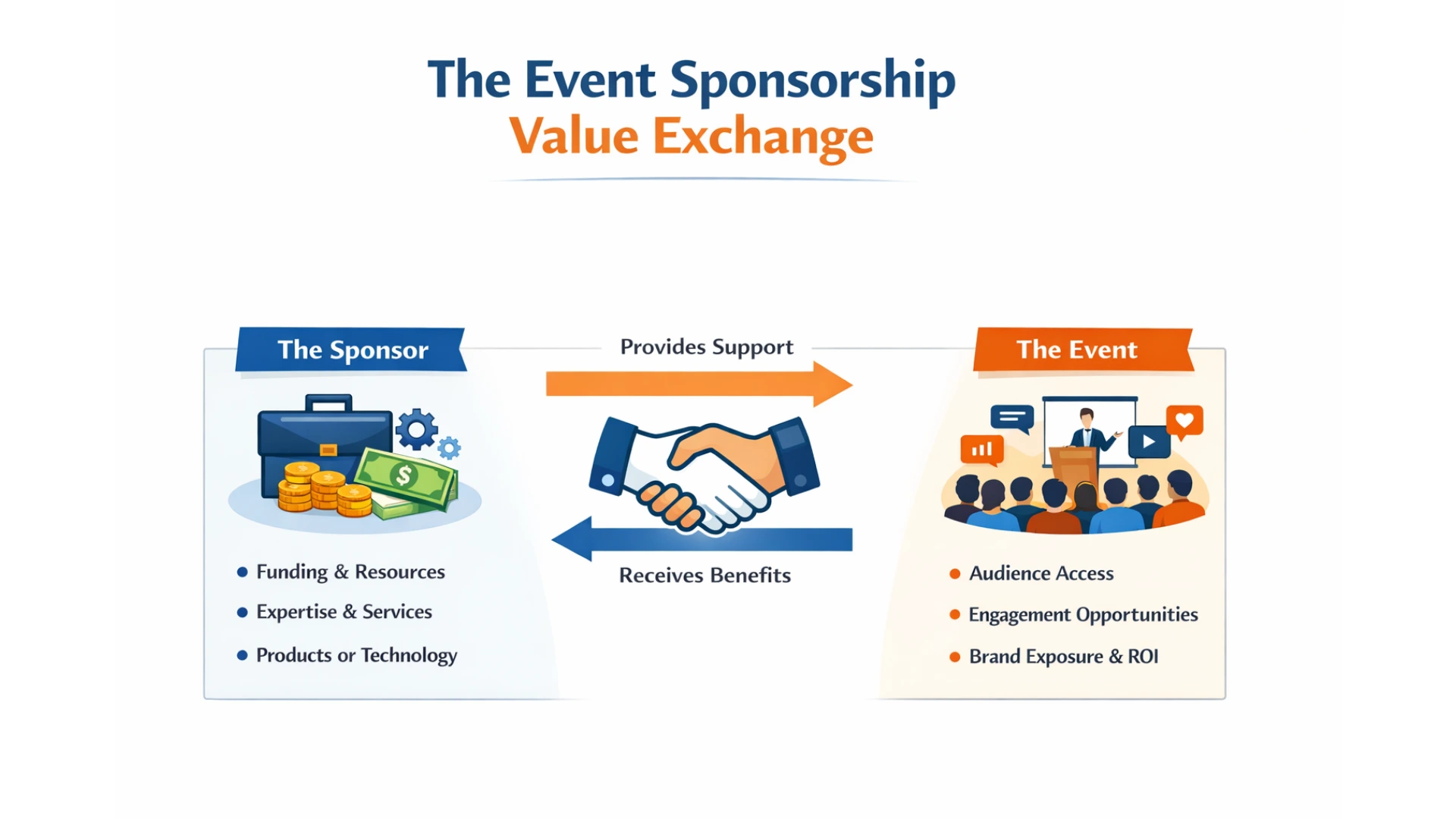
If you’ve ever asked yourself “what is event sponsorship really supposed to do?” you’re not alone. For years, event sponsorship was treated as a simple transaction: a brand pays, gets a logo, and everyone moves on. That model no longer holds up.
At its core, event sponsorship is a value exchange between an event and a brand. A sponsor provides funding, resources, or services. In return, the event offers access to a specific audience, opportunities for engagement, brand association, or measurable outcomes.
What’s changed is how that exchange shows up in practice.
In the past, sponsors often paid for logo placement and hoped the right people noticed. Interaction was limited, and impact was hard to measure. Today, event sponsorship is built around participation, hosting sessions, leading workshops, facilitating roundtables, or engaging attendees through on-site or virtual activations.
When done well, sponsoring an event places a brand inside moments where attendees are already engaged and forming opinions. Engagement replaces passive visibility, and interaction replaces interruption.
That’s why event sponsorship continues to outperform many traditional marketing channels, even as sponsor budgets tighten.
What Event Sponsorship Is Not
A lot of confusion around event sponsorship comes from outdated ideas that are still floating around. Let’s clear those up.
Event sponsorship is not:
- Just logos on banners, slides, or websites
- “Spray and pray” cold outreach sent to dozens of brands
- One-size-fits-all sponsorship packages copied from other events
- Simply a way to cover your event costs
When sponsorship is treated this way, sponsors rarely see real value, and organizers rarely see repeat deals. That’s when sponsorship starts to feel frustrating instead of strategic.
Why Brands Sponsor Events (And What They Look For)
Brands sponsor events because events create context and connection in a way most marketing channels can’t. Instead of competing for attention in a crowded feed, sponsoring an event allows brands to show up where people are already engaged and open to conversation.
At a high level, sponsors are motivated by a few core outcomes:
- Access to a focused audience that’s hard to reach elsewhere
- Credibility through association with events people trust
- Meaningful conversations that influence buying decisions over time
- Content and thought leadership that extends beyond the event
When it comes time to decide whether an event is worth sponsoring, brands tend to evaluate it through a short set of practical questions.
- Is the audience genuinely relevant, or just large on paper?
- Does the event align with my (sponsor brand’s) values and positioning?
- Will there be opportunities for real interaction, not just passive exposure?
- Can results be measured in a way that supports internal reporting?
- Does the organizer seem capable of delivering on what’s promised?
Understanding both why brands sponsor events and how they evaluate in-person and virtual event sponsorship opportunities helps explain why some sponsorships move forward quickly while others stall. When organizers design sponsorships with these factors in mind, sponsoring an event becomes a strategic decision rather than a leap of faith.
Event Sponsorship vs Traditional Advertising
Here’s where event sponsorship really stands apart.
When you understand how sponsorships work, this difference becomes clear. Event sponsorship isn’t just another ad format, it’s a way for brands to be part of an experience people actually care about.
And once organizers understand this shift, figuring out how to get sponsors for an event becomes much less about chasing logos, and much more about building real value on both sides.
.webp)
How Do Sponsorships Work? From First Contact to Post-Event

Event sponsorship often feels unpredictable because organizers tend to experience it in disconnected moments, an email here, a proposal there, a sponsor that goes quiet without explanation. In reality, sponsorship follows a fairly consistent process. When organizers understand that process end to end, it becomes much easier to see where things break down and how to fix them.
This section focuses on how sponsorships actually work, from the first internal decisions you make as an organizer all the way to the renewal discussion.
The Sponsorship Lifecycle
Most event sponsorships move through the same core stages, even if the timing or order shifts slightly.
1. Event positioning and audience definition
Before any sponsor conversation begins, an event needs clarity. Who is the event for? Why do people attend? What makes this audience valuable or difficult to reach? Sponsors don’t buy events in isolation, they buy access to people.
2. Sponsorship valuation
Once the audience is clear, the next step is understanding what the event is worth to sponsors. Valuation goes beyond attendance numbers. It includes audience relevance, level of access, engagement opportunities, content rights, and available data.
3. Sponsor research and shortlisting
Effective sponsorship doesn’t start with outreach. It starts with targeting, identifying brands that care about your audience and the right decision-makers within those target brands.
4. Outreach and discovery conversations
Here is where you begin reaching out to potential sponsors. Initial outreach should lead to conversations and discovery calls, not close deals immediately. Discovery conversations help organizers understand what sponsors are trying to achieve and whether the event is a fit.
5. Proposal and package customization
Only after discovery does it make sense to share a proposal. At this stage, sponsorship opportunities are framed around sponsor goals, not generic benefits. Customization doesn’t mean building everything from scratch, it means choosing what’s relevant and leaving the rest out.
6. Negotiation and contracting
Once both sides see value, details are finalized. This includes deliverables, timelines, exclusivity, payment terms, and expectations. Clear agreements reduce risk and prevent misunderstandings later.
7. Activation during the event
This is where sponsorship is experienced by attendees. Execution matters more than promises. Strong brand activation makes the sponsorship feel intentional and valuable rather than forced or invisible.
8. Reporting, follow-up, and renewal
Sponsorship doesn’t end when the event does. Post-event reporting, event metrics, and follow-up conversations close the loop. This stage is what turns a one-time sponsor into a repeat partner.
While not every sponsorship follows this perfectly, most problems come from skipping or rushing steps rather than from the steps themselves.
Common Sponsorship Models (And When to Use Them)
Once sponsors are interested, the structure of the sponsorship matters. Sponsorship models describe how opportunities are packaged, not how they’re pitched.
- Tiered packages (Gold, Silver, Bronze): Event sponsorship levels are familiar and easy to understand. They work best when benefits clearly scale with investment and when sponsors prefer predefined options.
- À la carte activations: This model allows sponsors to choose specific opportunities rather than buying a bundle. It works well for experienced sponsors or micro events where flexibility matters more than simplicity.
- Exclusive category sponsorships: By allowing only one brand per category, exclusivity removes direct competitors from the event, giving the sponsor undivided attention and stronger brand recall. This often increases perceived value as well.
- In-kind sponsorships: These involve services or resources instead of cash. Sponsors may provide technology platforms, media coverage, venue space, or logistics support in exchange for visibility, access to the audience, or brand association. This helps reduce event costs for the organizer while delivering value to the sponsor.
No single model is right for every event. The best structure depends on your audience, your event format, and what your prospective sponsors are actually trying to achieve.
Once you understand how sponsorships work at both the process and structural level, the next challenge becomes execution, how to package, pitch, and secure sponsors consistently.
Event Sponsorship Opportunities
Once organizers move past the idea that sponsorship is just about logos, a much bigger picture opens up. Event sponsorship opportunities are essentially all the meaningful ways a sponsor can participate in the event ecosystem: before it happens, while it’s live, and after it ends.
The most effective opportunities are designed around how attendees experience the event, not just where a brand’s logo appears. Below are the most common categories of event sponsorship opportunities, along with guidance on when and why they work.
1. Brand Visibility & Naming Opportunities
These are the most familiar sponsorship opportunities and often the easiest for sponsors to understand. They focus on where and how a brand is seen during the event experience.
Examples include title or naming sponsorships, stage or session sponsorships, track sponsorships, and branding across event signage, websites, and registration pages. When done thoughtfully, these placements reinforce brand presence without overwhelming the audience.
Where organizers go wrong is treating visibility as value on its own. Brand visibility works best when it’s tied to context. For example, a collaboration tool sponsoring a virtual networking lounge or breakout sessions feels relevant to how attendees are already interacting, while the same logo placed generically across the platform is easy to overlook. The goal isn’t maximum exposure, it’s meaningful exposure.
2. Content & Marketing Sponsorship Opportunities
Content-driven sponsorships extend the value of sponsoring an event far beyond event day. These opportunities are especially attractive to brands focused on long-term visibility and authority rather than immediate leads.
Sponsors may support pre-event email marketing campaigns, branded agendas or programs, blog posts, social media takeovers, or video content such as session recordings.
What makes these opportunities powerful is longevity. Content lives on after the event ends, reaching attendees who couldn’t attend live and new audiences altogether. For sponsors, this often feels closer to a content investment than a traditional sponsorship, and that’s a good thing.
3. Experience & Engagement Opportunities
Experience-based sponsorships are often the highest-performing opportunities because they’re built around interaction, not passive visibility.
These include interactive booths, product demos, workshops, hands-on labs, roundtables, invite-only sessions, and sponsored networking moments like coffee breaks or mixers. In these settings, sponsors aren’t just present, they’re participating.
From a sponsor’s perspective, these opportunities feel more authentic. Conversations happen naturally. Attendees opt in rather than being interrupted. When designed well, experience-based sponsorships can deliver deeper engagement than any banner or logo placement ever could.
4. Virtual Event Sponsorship Opportunities
Virtual events offer specific sponsorship opportunities that are often easier to measure and scale than traditional on-site placements. Sponsors can support virtual stages, breakout rooms, and networking lounges, while virtual booths and demo rooms enable real interaction without physical constraints.
The effectiveness of virtual event sponsorship opportunities depends heavily on the virtual event platform being used. Different platforms enable different levels of interaction, visibility, and data access.
For example, on Remo, sponsors can host branded virtual tables, join networking conversations, run live demos, or share sponsored content through subtle content banners placed across the event space. They can also sponsor interactive areas where attendees naturally gather, making brand presence feel native to the experience rather than layered on top of it.
Successful virtual sponsorships are built around integration. When a sponsor’s presence aligns with how attendees move, network, and engage on the platform, virtual placements can rival, or outperform, in-person sponsorships.
5. Merchandise & Physical Touchpoints
Physical sponsorship opportunities focus on tangible brand touchpoints that attendees take with them.
These include event merchandise such as t-shirts, lanyards, or badges, as well as swag bags, notebooks, or practical items like water bottles and charging stations. While these opportunities are more traditional, they still work when the item is genuinely useful and aligned with the brand.
The difference between effective and forgettable merchandise sponsorship is intent. Practical, well-designed items are kept and reused. Generic swag is ignored. Sponsors increasingly care about quality over quantity here.
6. Strategic & In-Kind Sponsorship Opportunities
Not all sponsors contribute cash. Strategic and in-kind sponsorships involve brands providing resources that directly support the event.
Media partners may offer promotion or coverage. Technology partners might provide event platforms, apps, AV, or connectivity. Venues, logistics providers, or food and beverage brands may reduce costs in exchange for visibility and association.
These partnerships can significantly lower event expenses while still creating meaningful sponsor value. They work best when treated as true collaborations rather than discounted sponsorships.
Event sponsorship opportunities aren’t about offering every option imaginable. They’re about selecting the right mix based on your event format (in-person, virtual, or hybrid) and your sponsors’ goals.
Once organizers clearly understand what they can offer, the next challenge becomes shaping those opportunities into sponsorship packages that make sense commercially and strategically.
Event Sponsorship Packages

Before you can build sponsorship packages that convert, you need to understand what you’re actually selling. Sponsorship packages don’t create value on their own. They’re made up of individual sponsorship assets, and each asset has its own potential value depending on how a sponsor can use it.
This section breaks the process into two clear steps:
- Valuating individual sponsorship assets
- Grouping those assets into packages that make sense to sponsors
Getting this right is what turns sponsorship from guesswork into a repeatable, defensible revenue stream.
How to Value Event Sponsorship Assets
Sponsorship asset valuation is the process of pricing each sponsorship opportunity before you bundle anything into a package. It’s also one of the hardest parts of event sponsorship to get right.
Price too high and you risk turning sponsors away. Price too low and you leave money on the table. There’s rarely a perfect number, just a range that feels justified to both sides.
Assets that offer broad reach with low effort (like emails or platform placements) are typically priced based on audience size and engagement, while assets tied to authority or conversation (like speaking or networking) command a premium.
Assets might include speaking slots, booths, sponsored emails, virtual stages, branded networking sessions, or demo rooms. Their value isn’t fixed. It depends on a number of factors, such as:
- Audience quality, not audience size
- Level of access to attendees
- Exclusivity within a category or moment
- Engagement and data, not just impressions
Typically, organizers price assets by reviewing what similar events charge, looking at industry norms, and applying their best judgment based on their audience and format. However, it’s more of an art than science which tends to introduce a lot of uncertainty over what the “right” price is.This uncertainty is why sponsorship valuation often feels uncomfortable.
If you want a more structured way to price sponsorship assets, Sponsor Genius Bar by Events.com helps organizers do this with logic. The course includes valuation calculators, templates, and coaching to take the guesswork out of sponsorship pricing and help you price with confidence.
Getting asset valuation right makes everything that follows easier, from packages and proposals to negotiation and renewals.
How to Form Sponsorship Packages or Levels
Once assets are valued individually, the next step is building sponsorship packages that are easy to understand and easy to buy.
Most organizers choose between two common approaches:
- Tiered packages (such as Gold, Silver, Bronze), which work best when benefits clearly scale with price
- Modular or build-your-own packages, which allow sponsors to select assets aligned with their specific goals
In both cases, fewer options usually convert better. Too many packages can overwhelm sponsors, especially first-time ones, and slow down decisions.
Strong sponsorship packages tend to:
- Combine assets that naturally work together
- Reflect sponsor goals rather than organizer convenience
- Make trade-offs clear, such as access vs. visibility or exclusivity vs. scale
When packages are designed this way, they feel like solutions to real sponsor needs, not just a collection of perks.
For a deeper breakdown of how to structure and price packages, take a look at our detailed guide on building event sponsorship levels, which walks through common models and when to use them.
Once your packages are clear, creating tailored sponsorship proposals becomes far more straightforward, because you’re starting with a structure that already makes sense for sponsors.
Event Sponsorship Proposals
Once a sponsor shows interest, the next question is often misunderstood: Should you send a proposal right away? This is where many sponsorship conversations quietly fall apart.
An event sponsorship proposal isn’t a cold pitch or a brochure. It’s a decision document, one that helps a sponsor decide whether your event is the right investment for their goals. When used correctly, proposals move deals forward. When used too early or too broadly, they stall them.
What Is an Event Sponsorship Proposal?
An event sponsorship proposal is a tailored document that outlines how a sponsor can achieve specific outcomes through your event. It’s not meant to introduce your event for the first time, and it’s not a list of everything you offer.
This is what separates proposals from other materials:
- Decks and one-pagers are exploratory. They spark interest.
- Proposals are evaluative. They support a yes-or-no decision.
A strong proposal assumes context. It reflects what you’ve already learned during discovery conversations and shows the sponsor that you understand what they’re trying to achieve. That’s why proposals work best when they feel specific, not exhaustive.
How to Create a Strong Sponsorship Proposal
The best sponsorship proposals are focused. They don’t try to sell everything, they recommend the right things. A solid proposal usually includes:
- A sponsor-focused event overview: This isn’t a general description of your event. It’s a short explanation of why this event makes sense for this sponsor.
- Audience and value summary: Highlight the parts of your audience that matter most to the sponsor. This is where relevance beats volume.
- Recommended sponsorship opportunities: Instead of listing every possible option, select the opportunities that align with the sponsor’s goals. Fewer, well-chosen recommendations convert better than long menus.
- Activation ideas tied to sponsor goals: Show how the sponsor will actually show up. Whether it’s a speaking slot, demo, workshop, or virtual activation, this section connects assets to outcomes.
- Measurement and reporting plan: Sponsors want to know how success will be evaluated. Even simple metrics build confidence and reduce risk.
If you’re starting from scratch every time, it’s a sign you need a better system. The Sponsor Genius Bar template pack removes the guesswork with ready-to-use sponsorship proposals, so your next pitch is minutes away, not days. Get the templates and start pitching faster.
When (and When Not) to Send a Sponsorship Proposal
Timing matters as much as content.
A proposal should almost always come after a discovery conversation. Sending one too early, before you understand the sponsor’s goals, often turns a conversation into a stalled email thread.
The best time to send a proposal is when both sides agree there’s a potential fit and the sponsor needs something concrete to review internally.
When proposals are positioned as helpful decision tools rather than sales documents, they stop feeling heavy, and start moving deals forward.
Handled well, sponsorship proposals create a natural bridge between interest and commitment. And once you’re confident in how to create and use them, the final step becomes much easier: asking for sponsorship in a way that feels clear, relevant, and aligned with sponsor goals.
Finding and Reaching the Right Event Sponsors

At this point, you’ve already done the hard thinking. You understand what sponsorship is, how it works, how to value assets, and how to build proposals. What’s left is execution, finding the right sponsors and starting the right conversations.
This is where many organizers get stuck. Not because sponsorship doesn’t work, but because they reach out before their value is clear or to sponsors who were never a fit to begin with. Securing sponsors consistently isn’t about sending more emails. It’s about being precise. Everything in this section builds toward that goal.
Step 1 – Define Sponsor Value (Before You Reach Out)
Before you contact a single sponsor, you need to be able to answer one simple question from their point of view:
Why should we sponsor this event?
This isn’t about your mission or how much effort you’ve put in. It’s about how your event fits into a sponsor’s world and supports their goals.
Start by looking at your attendees through a sponsor’s lens. Who are they really? What roles do they hold? What decisions do they influence? Where are they in the buying journey when they attend?
At a minimum, you should be clear on four things sponsors use to evaluate value:
- Who your attendees are from a commercial perspective
- What problem your event helps sponsors solve, such as lead generation, education, or trust-building
- Why this audience is hard to reach through traditional paid marketing, due to specialization, scarcity, or timing
- What data sponsors can use to justify the spend, including demographics, engagement, or past outcomes
When sponsor value is clearly defined, outreach stops feeling awkward. You’re no longer asking brands to support your event “just because”, you’re presenting a specific opportunity that aligns with their goals.
Step 2 – Build a High-Intent Sponsor Target List
Once sponsor value is clear, the next challenge is volume. Many sponsorship efforts stall simply because there aren’t enough qualified leads to create momentum.
How many leads is “enough”? A simple framework to keep in mind is the 10-10-10 rule. To secure around 10 sponsors, you typically need roughly 100 real conversations, which usually means starting with a much larger pool of potential leads. Two or three prospects is not a pipeline.
When building your target list, focus on sponsors who already have a reason to care about your audience:
- Past sponsors and warm leads
- Brands already advertising to your audience
- Sponsors of comparable events
A strong sponsor list isn’t just company names. It includes multiple relevant decision-makers per company and enough volume to support outreach without pressure. This is where lead generation tools can help to identify the right contacts inside target companies, rather than guessing who to reach out to. (We cover these tools in more detail in our guide on webinar lead generation.)
With the right list in place, and the right contacts identified, outreach becomes far more effective.
Step 3 – How to Ask for Event Sponsorship (Outreach That Gets Responses)
Event sponsorship outreach isn’t about pitching, it’s about starting a conversation. The outreach that gets responses is short, relevant, and sponsor-first. A strong initial message usually does three things:
- Explains why you’re reaching out to this sponsor
- Connects the event audience to the sponsor’s world
- Invites a conversation, not a commitment
Personalization should be light but intentional. One genuine signal of relevance is enough. Overdoing it often feels forced.
Follow-up matters more than the first email. Silence doesn’t always mean no, it often means low priority. That’s why outreach works best as a campaign, not a handful of messages. A simple rhythm, initial outreach, one follow-up, and a final nudge, is usually enough to surface interest.
It’s also worth remembering that outreach isn’t limited to email. The strongest sponsorship outreach layers multiple channels, such as LinkedIn messages, referrals, SMS, or even phone calls, to reinforce familiarity and increase response rates.
Whenever possible, warmer channels outperform cold ones, but consistency across channels is what keeps conversations moving.
Once a sponsor engages, the focus shifts from outreach to conversation.
Step 4 – The Art of Discovery Calls
When a sponsor agrees to talk, the goal is not to pitch, it’s to understand.
A discovery call should focus on listening. Ask what the sponsor is trying to achieve through event sponsorship, how they measure success, what timelines they’re working with, and who’s involved in the decision.
Use the call to surface:
- Goals and priorities
- Budget and timing context
- Level of intent
Then, you can use what you’ve learned to tailor a sponsorship proposal specifically to that sponsor, rather than sending a generic package. Sending it shortly after this initial conversation keeps momentum high and shows you were listening.
Objections around budget or ROI are normal. They usually signal misalignment, not rejection. Revisiting goals, simplifying the offer, or clarifying success metrics often resolves them.
It’s also important to know when to walk away. Not every sponsor is a fit, and accepting a clear no, rather than forcing a partnership, protects your event and your long-term strategy.
Step 5 – Closing & Contracting
Closing a sponsorship deal is about clarity, not pressure. By this stage, both sides should already feel aligned on value.
Before closing, make sure there’s shared understanding around:
- What the sponsor is getting, including specific deliverables
- When and how those deliverables will be activated
- How success will be measured and reported
Clear timelines and metrics reduce friction later. Sponsors should know when branding appears, when sessions happen, and when reporting will be shared.
Payment terms should also be agreed upfront, including pricing, payment schedule, and how changes are handled. Simple risk-reduction clauses protect both sides and set realistic expectations.
When closing and contracting are handled with transparency, sponsorships start on solid ground, and are far more likely to continue beyond a single event.
Sponsorship Activation That Delivers Real Value

It’s one thing to sell a compelling sponsorship package. It’s another thing to actually deliver on it.
You can promise visibility, engagement, and results, but if the on-site or in-platform experience doesn’t live up to those promises, you’re not just risking a bad outcome, you’re damaging trust, which is what ultimately drives renewals in event sponsorship.
When sponsors feel that what they were sold is what they actually received, they’re far more likely to sponsor again, increase their investment, or recommend your event to their network. When delivery falls short, even a well-priced sponsorship can feel like a miss.
This section focuses on sponsorship activation, how sponsorships show up in real life, how they’re experienced by attendees, and how they’re judged by sponsors once the event is over.
What Makes a Sponsorship Feel Successful
From the sponsor’s perspective, a successful sponsorship isn’t measured by how many logos were displayed. It’s measured by whether the experience matched their expectations and supported their goals.
At a basic level, sponsors are looking for four things.
1. Engagement, not impressions
Nowadays, sponsors care less about how many people saw their brand and more about how many actually interacted with it. Conversations, clicks, questions, and participation matter far more than passive exposure.
2. Meaningful conversations
The best sponsorships create moments where real dialogue happens. Whether that’s through a booth, workshop, roundtable, or virtual session, sponsors value quality interactions over volume.
3. Clear brand association
Sponsors want attendees to understand why they were involved. Confusing or invisible placements weaken impact. Clear association, tied to a session, theme, or experience, makes sponsorship feel intentional rather than random.
4. Meeting sponsor goals
Ultimately, success is defined by alignment. If a sponsor wanted leads, did the activation support lead generation? If they wanted thought leadership, did the format reinforce credibility? When delivery matches the goal, sponsors feel the sponsorship worked, even if results weren’t perfect.
When organizers think about activation from this perspective, sponsorship stops being about checking boxes. It becomes about creating experiences that sponsors can clearly point to and say, “This did what we hoped it would.”
That mindset is what turns first-time sponsors into long-term partners
Designing Better On-Site and Virtual Activations
The most effective sponsorship activations are designed intentionally. They account for how attendees move through the event and what kind of interaction a sponsor wants, whether that’s real conversation or simple, self-guided engagement.
The goal of good activation design isn’t to force attention. It’s to place sponsors where interaction already makes sense. When flow, format, and sponsor goals are aligned, sponsorship feels like part of the event experience rather than an interruption.
If you’re looking for concrete examples of what strong brand activations look like in practice, across both on-site and virtual events, this brand activations guide breaks down real ideas, formats, and use cases worth borrowing. It’s a helpful next read for turning these principles into activation concepts that actually work.
Measuring Sponsorship ROI
Measuring sponsorship ROI doesn’t require complex dashboards or perfect attribution. What sponsors want most is evidence that the activation delivered against the goals that were agreed upfront.
The most useful sponsorship reporting focuses on a few core areas:
- Leads and meetings: Qualified leads captured, demos completed, meetings booked, or follow-up conversations scheduled.
- Content engagement: Session attendance, video views, downloads, chat participation, poll responses, or time spent with sponsored content.
- Post-event brand lift indicators: Survey responses, qualitative feedback, social mentions, repeat engagement, or increases in branded search or website traffic.
Sponsors expect transparency. When reporting is aligned with original goals and communicated clearly, it reinforces trust and makes future sponsorship conversations much easier.
Event Sponsorship Trends Shaping 2026
Event sponsorship isn’t changing because events are changing. It’s changing because sponsors are changing how they buy, how they measure success, and what they expect in return for their investment.
By 2026, sponsorship is less about presence and more about participation. The organizers who adapt to these shifts won’t just close more deals, they’ll retain sponsors longer and build partnerships that compound over time.
Here are the trends shaping where event sponsorship is headed next.
1. From Logos to Experiences
Passive branding is steadily losing value. Sponsors are no longer satisfied with visibility alone, especially when that visibility can’t be tied to engagement or outcomes.
What’s replacing it are experience-led sponsorships, workshops, roundtables, hosted networking moments, interactive demos, and content-led activations. Sponsors want to be part of the event experience, not placed beside it.
For example, instead of sponsoring a logo on a main stage, a sponsor might host a short, practical session where attendees learn a specific skill or walk away with something actionable. Attendees remember the experience, not just the brand name, and sponsors see higher engagement as a result.
Logos still matter, but they work best when they’re attached to something attendees actually remember.
2. Data and Accountability Matter More Than Ever
Sponsors are under more internal scrutiny than before. Budgets are tighter, and every investment needs justification.
As a result, sponsors increasingly expect:
- Clear success metrics tied to their goals
- Post-event reporting that goes beyond impressions
- Transparency around what worked and what didn’t
For example, instead of reporting that “5,000 attendees saw the sponsor logo,” organizers might share how many attendees joined a sponsored session, booked meetings, downloaded content, or engaged with a demo. Even directional insights help sponsors tell a stronger internal story.
3. Brand and Event Values Alignment
Sponsorship decisions are no longer made in isolation. Brands are paying closer attention to who they’re associated with and what an event represents.
Environmental impact, accessibility, inclusion, and social responsibility increasingly influence sponsorship decisions, especially for larger or more visible brands. A mismatch in values can quietly kill a deal before it ever reaches a proposal.
Organizers who are clear about their values, and reflect them in how events are run, make it easier for sponsors to say yes with confidence.
4. Digital-First Sponsorship Models
Virtual and hybrid events have permanently expanded what sponsorship can look like. Even for in-person events, digital layers now play a bigger role in sponsor value.
Digital-first sponsorships include virtual sessions, branded networking rooms, and in-platform messaging. These opportunities often perform well because they’re easier to measure and extend sponsor visibility beyond event day.
For instance, a sponsor might support a virtual session that remains available on demand for months, continuing to generate engagement long after the live event has ended.
5. Year-Round Sponsorship Extensions
More sponsors are moving away from one-off activations and toward ongoing presence.
Instead of sponsoring a single event, they want visibility across multiple touchpoints, event series, ongoing content, or year-round communities. This might look like a sponsor supporting quarterly events or being integrated into newsletters, recordings, or forums throughout the year.
For organizers, this creates more predictable revenue and deeper relationships.
6. Long-Term Partnerships Over One-Off Deals
All of these trends point to the same outcome: sponsorship is becoming more relational.
Sponsors are looking for partners who understand their goals, deliver consistently, and improve over time. Organizers who prioritize renewals, feedback, and long-term alignment will outperform those constantly chasing new sponsors.
By 2026, the most successful sponsorship strategies won’t be built on clever packages or aggressive outreach. They’ll be built on trust, delivery, and partnerships that grow stronger with each event.
Build Sponsorships That Actually Last
Event sponsorship isn’t about closing a deal once. It’s about building relationships that carry forward from one event to the next.
When organizers focus on understanding sponsor goals, delivering on what was promised, and reporting honestly on outcomes, sponsorship stops feeling fragile. It becomes repeatable. Sponsors come back not because of clever packages, but because they achieved their goals.
That long-term mindset is what separates one-off sponsorship wins from sustainable revenue. Delivery matters just as much as outreach. Engagement matters more than impressions. And trust is what ultimately drives renewals.
If you want a practical, step-by-step way to apply everything covered in this guide, from valuation and packaging to outreach, proposals, and activation, sign up for Sponsor Genius Bar. It’s a part course, part community, part coaching program, designed to help organizers turn sponsorship frustration into sponsorship revenue.
If your sponsorship strategy is in place and you’re looking for a virtual event platform built for real engagement and sponsor value, book a demo with Remo.
Frequently Asked Questions about Event Sponsorship
1. What is event sponsorship?
Event sponsorship is a value exchange where a brand provides funding, resources, or services in return for access to an event’s audience, engagement opportunities, or measurable outcomes. When done well, it supports sponsor goals like lead generation, trust, or thought leadership, not just visibility.
2. What are the types of event sponsorship?
Common types include brand visibility sponsorships, content and marketing sponsorships, experience-based sponsorships, virtual event sponsorships, merchandise sponsorships, and in-kind or strategic partnerships. The right mix depends on your event format and sponsor goals.
3. How do I identify the right sponsors whose target audience matches my event attendees?
Start by understanding your audience’s roles, interests, and buying influence. Then look for brands already advertising to similar audiences or sponsoring comparable events. Relevance matters more than brand size.
4. How do I reach out to potential sponsors and who inside the company should I contact?
Outreach should start a conversation, not a pitch. At larger companies, marketing or partnerships teams are often the right contact; at smaller teams, founders or operational leaders are more responsive. Keep messages short and relevant, warm introductions and LinkedIn usually outperform cold email.
5. What should I include in a sponsorship proposal or pitch deck to win sponsors?
Focus on a sponsor-specific event overview, a clear audience summary, recommended opportunities aligned to sponsor goals, activation ideas, and how success will be measured. Send proposals after a discovery call, not as a first touch.
Zainab Asad
Zainab Asad is a Content Writer at Remo, contributing to the platform's mission of fostering authentic virtual connections. With a keen eye for detail and a passion for effective communication, she crafts engaging content that empowers event professionals to create memorable virtual experiences.